
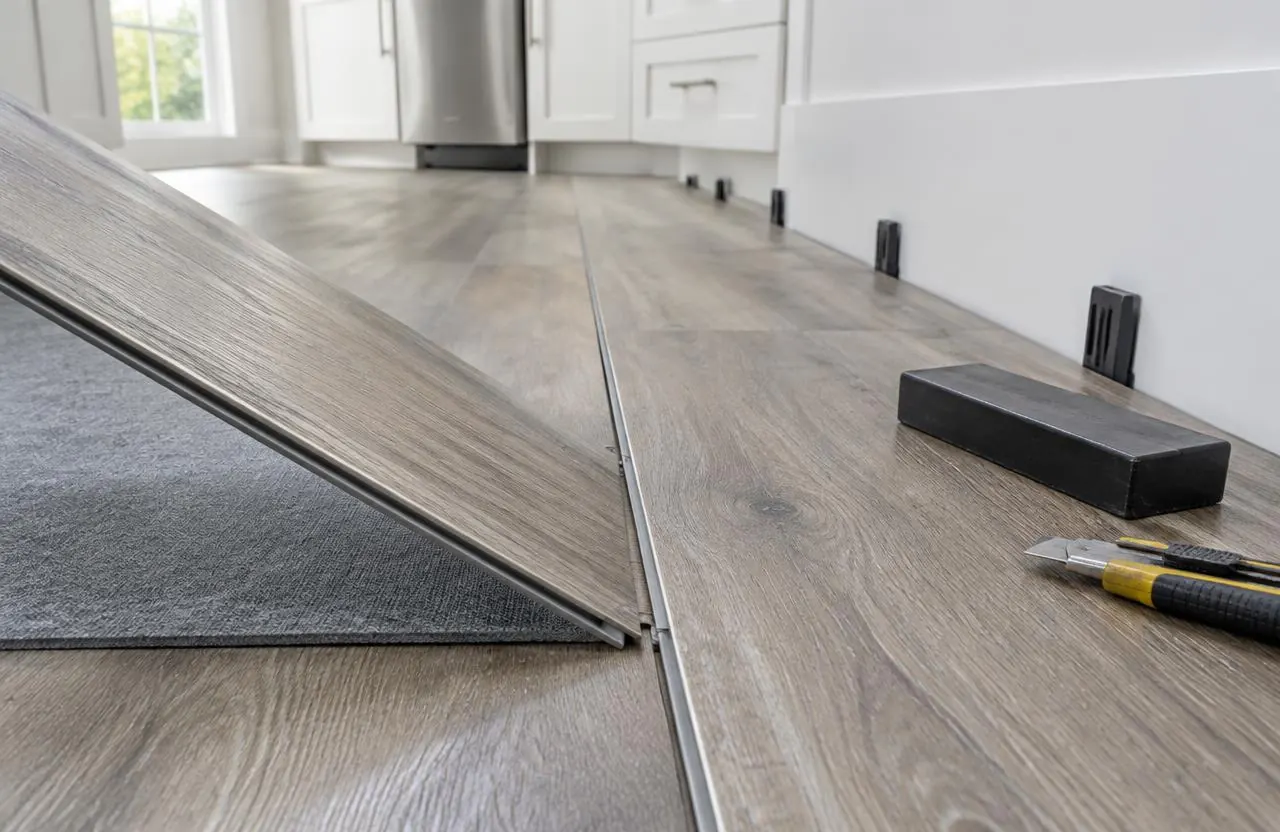
LVP, LVT or sheet vinyl?
“Vinyl flooring” covers several different products. The format affects how it looks, how water behaves at the seams and how it is installed.
| Format | What it is | Seams | Common use |
|---|---|---|---|
| Luxury vinyl plank (LVP) | Plank-shaped vinyl, often wood-look; flexible or rigid core | Many joints, click or glued | Living areas, kitchens, basements |
| Luxury vinyl tile (LVT) | Tile-shaped vinyl, often stone- or tile-look | Many joints; some allow grout strips | Kitchens, laundry, entries |
| Sheet vinyl | Wide rolls with few or no seams | Few seams; can be heat-welded in commercial grades | Bathrooms, laundry, utility rooms |
| Rigid core (SPC/WPC) | Plank or tile with a stiff stone-polymer or foamed core | Click joints | Floating floors over imperfect but within-tolerance subfloors |
Click floating floor or glue-down?
Click vinyl locks plank to plank and floats over the subfloor. It installs quickly and can go over many existing hard floors, but needs expansion space at walls and should not be pinned down by heavy fixed items. Glue-down vinyl bonds to the subfloor, handles rolling loads and large open areas better, and suits commercial spaces — but needs a smoother, cleaner subfloor and more preparation.
| Factor | Floating click | Glue-down |
|---|---|---|
| Subfloor preparation | Must meet flatness tolerance; minor texture tolerated | Smooth, clean and flat; imperfections telegraph |
| Expansion space | Required at walls and fixed objects | Generally not required in the same way |
| Heavy cabinets and islands | Many makers say do not install underneath | Can usually run under fixed cabinetry |
| Large open areas | May need transition breaks per instructions | Continuous runs are more common |
| Repairs | Planks can sometimes be unclicked and replaced | Individual planks can be cut out and re-glued |
Flatness, underlayment and warranty compatibility
Every vinyl product sets a flatness tolerance for the subfloor. Rigid planks bridge small dips but can flex and stress the joints over larger ones; flexible and glue-down products show every bump. Levelling compound and sanding high spots are often the most important — and least visible — parts of a vinyl installation.
Many rigid planks come with an attached underlayment. Adding a second underlayment under them can void the warranty or make the joints flex. If an acoustic underlayment is required, for example by a condo corporation, choose one the plank manufacturer approves for that product.
A waterproof plank is not a waterproof floor
Many vinyl products are marketed as waterproof, meaning the plank itself will not swell from water. The floor assembly is a different matter. Water from a leaking dishwasher, a toilet overflow or a flooded basement can travel through click joints and around the perimeter, then sit on the subfloor underneath, where it can damage wood subfloors or feed mould.
In bathrooms and laundry rooms, follow the manufacturer’s wet-area instructions, which may call for sealant at perimeters and penetrations, specific installation patterns or glue-down installation. Showers and other areas of standing water need a tiled or purpose-designed waterproofing system, not vinyl plank.
Vinyl in Ottawa basements
Rigid vinyl plank is a common choice over basement slabs because it tolerates cool, humid conditions better than wood or laminate. The slab still needs a moisture assessment: high slab moisture can trap water under the floor, affect adhesives and lead to odours. Relative humidity testing in concrete under ASTM F2170 is one of the methods manufacturers reference.
Installing vinyl over existing floors
Vinyl can often go over sound, flat existing floors, including ceramic tile, if grout lines are filled or skimmed so they do not telegraph through. Over old cushioned vinyl or carpet, it usually cannot. Raising the floor height also affects doors, transitions and appliance clearances under counters.
Older sheet vinyl, vinyl tile and their adhesives can contain asbestos, so they are assessed before they are disturbed. Ontario’s asbestos regulation (O. Reg. 278/05, section 10) sets owner duties before alteration or repair work is arranged: material likely to be disturbed is examined unless its asbestos content is already known or the work is planned as though it contains asbestos. Covering a sound old floor rather than removing it is sometimes the practical choice — but that is a decision to make with the facts.
Transitions, stairs and heavy loads
Long floating runs and doorways may need T-mouldings per the manufacturer’s instructions. Stairs need matching stair nosings or a stair-specific product, and each tread is usually glued. Plan for where kitchen islands, built-ins and heavy appliances sit: on a floating floor, they are installed on top only if the manufacturer allows.
Sunlight and temperature
Some vinyl products set limits on direct sunlight and on temperature ranges, which matters for south-facing rooms, sunrooms and unheated cottages or garages in an Ottawa winter. Large temperature swings can cause gapping or peaking in floating floors. Check the product’s limits for the room, and remember that vinyl flooring is an indoor product — see waterproof outdoor flooring for balconies and patios.
What shapes vinyl installation cost
Preparation often costs more than people expect.
- Removal of the existing floor, including any asbestos assessment or controls older vinyl requires
- Levelling and subfloor repair to meet tolerance
- Product format, wear layer and core
- Glue-down versus floating installation
- Stairs and nosings
- Transitions, trim and appliance moves
Common questions
Can you install vinyl flooring over tile?
Often, if the tile is sound and flat and grout lines are filled or skimmed so they do not show through. Height changes at doors and transitions need checking.
Is click vinyl or glue-down vinyl better?
Click vinyl is faster and floats over many existing floors; glue-down is better for rolling loads, large open areas and running under fixed cabinets. The subfloor and use decide.
Is waterproof vinyl enough for a basement?
The plank may be waterproof, but the slab still needs a moisture assessment. Water or high slab moisture can still collect under the floor.
Can vinyl plank go in a bathroom?
Often in bathrooms without standing water, following the manufacturer’s wet-area instructions. Showers need a tiled or purpose-designed waterproofing system.
Can vinyl flooring go under kitchen cabinets?
Glue-down vinyl usually can. Many floating click products should not be installed under heavy fixed cabinets or islands — check the manufacturer’s instructions.
Can vinyl plank flooring be used outdoors?
No. Indoor vinyl is not designed for UV, freeze-thaw and exterior drainage. Use an exterior-rated surface instead.