
What “waterproof” means outdoors
Indoors, a waterproof floor mostly needs to survive spills. Outdoors in Ottawa, the floor sits in snow and meltwater for months, freezes and thaws repeatedly, and bakes in summer sun. Any water trapped in or under the surface expands when it freezes, cracking tile, lifting pavers and damaging the structure beneath.
So the goal is not just a surface that sheds water, but an assembly where water drains away quickly and the surface tolerates whatever stays.
Why indoor vinyl and laminate do not belong outside
People often ask whether waterproof vinyl or laminate can be used outdoors. They are not designed for it: UV breaks down the surface, freeze-thaw and temperature swings make floating floors gap and buckle, and water trapped under them has nowhere to go. Epoxy coatings are another common question; many are not UV-stable and can yellow or chalk outside unless the product is specifically rated for exterior exposure.
Exterior-rated options
The right option depends on what is underneath: a concrete slab on grade, a wood-framed deck, a balcony slab or a roof over living space.
| Option | How it works | Suits | Watch for |
|---|---|---|---|
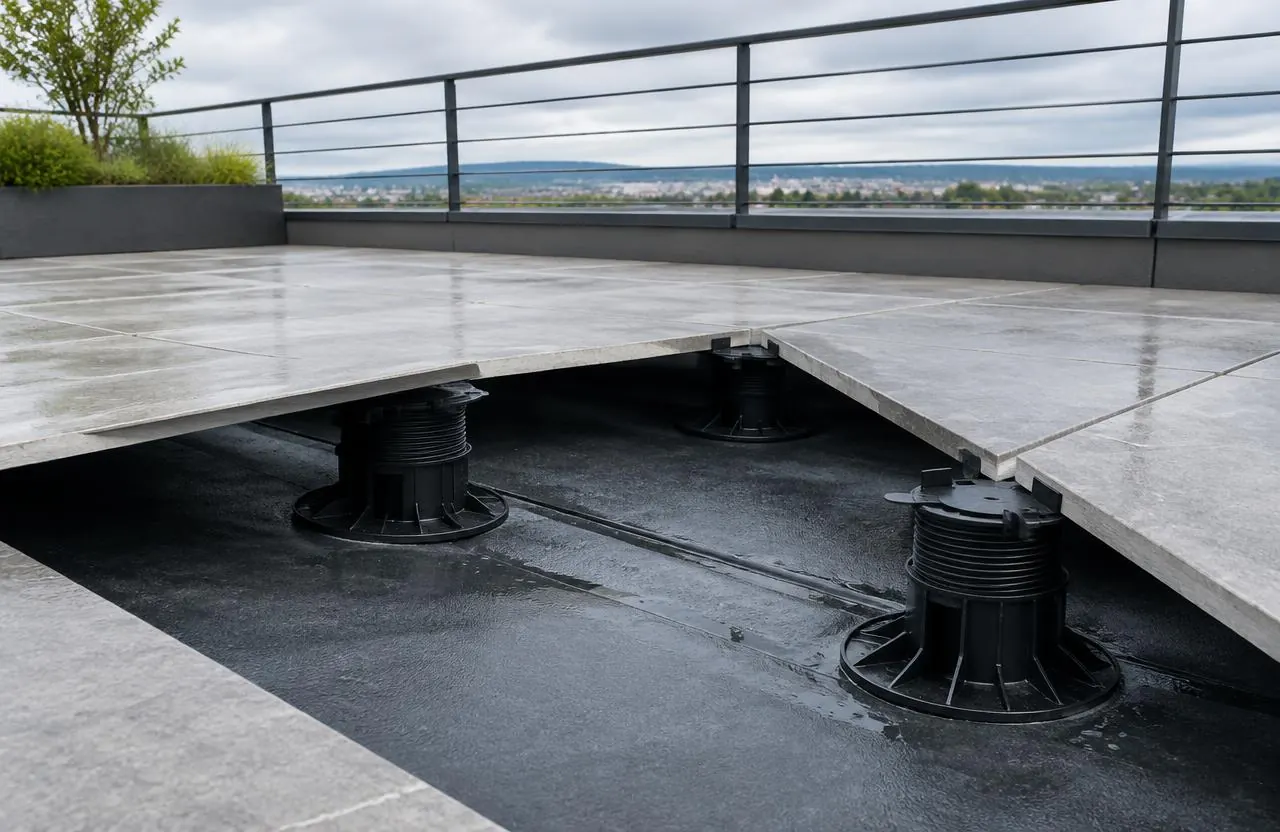
| Porcelain pavers on pedestals | 2 cm pavers set on adjustable supports with open joints | Roof terraces and balconies over membranes | Wind uplift, edge restraint, load on the structure |
| Bonded exterior porcelain tile | Tile bonded over a sloped, waterproofed and drained assembly | Patios and some balconies | Requires frost-resistant tile and an exterior-rated system |
| Porcelain pavers on grade | Pavers on a compacted, drained base | Patios at ground level | Base preparation and frost movement |
| Composite or PVC decking | Boards over framing with gaps to drain | Wood-framed decks | Heat in sun, framing condition, fastener spacing |
| Deck tiles (interlocking) | Modular tiles over an existing surface | Light-duty balcony refresh | Drainage underneath and wind |
Freeze-thaw and product data
For tile and pavers, ask for the exterior data: water absorption (porcelain is typically 0.5 percent or less under ASTM C373) and freeze-thaw resistance tested under ASTM C1026. NTCA guidance on gauged porcelain pavers on pedestals notes that these unbonded systems offer level walking surfaces, better water management and less chance of freeze-thaw damage and efflorescence.
Membranes, slope and drainage
When a balcony or terrace sits over a room, the waterproof layer is a membrane on the structure, sloped to drains or scuppers. The walking surface protects that membrane and must not block drainage. Before any new surface goes down, the membrane’s condition, slope and drains are assessed — replacing pavers over a failing membrane only hides the problem.
Structure, load and wind
Porcelain pavers, pedestals and bonded tile assemblies add weight, and rooftop installations can be exposed to strong wind. Load capacity, edge restraint and wind uplift are reviewed for the specific structure, with professional input where needed.
Condos and shared buildings
Condo balconies and terraces are often common elements or exclusive-use common elements, and many corporations restrict what owners can install. Approval from the condominium corporation or property manager comes before product selection.
Winter care
Use plastic shovels, avoid metal edges that chip tile or scratch decking, and check the surface manufacturer’s guidance on de-icing products — some salts damage concrete, stone and grout. Keep drains clear of leaves and ice.
What shapes outdoor flooring cost
The surface is often the smaller part of the scope.
- Removal of the existing surface
- Membrane repair or replacement, and drainage work
- Pedestal heights, slope correction or base preparation
- Product type and exterior rating
- Edges, railings, thresholds and door sills
- Access for materials on upper floors or rooftops
Common questions
Can waterproof vinyl flooring be used outdoors?
No. Indoor vinyl is not designed for UV, freeze-thaw cycles or exterior drainage, even if the plank itself is waterproof.
What is the best waterproof outdoor flooring for an Ottawa balcony?
It depends on the structure. Porcelain pavers on pedestals over a sound membrane are a common choice; the membrane, drainage and condo rules decide what is suitable.
Is porcelain tile frost-proof?
Porcelain tested for freeze-thaw resistance under ASTM C1026 and with very low absorption is suitable for exterior use when installed in an exterior-rated, drained assembly.
Is epoxy flooring good outdoors?
Many epoxies are not UV-stable and can yellow or chalk outside. Only use coatings specifically rated for exterior exposure.
Does outdoor flooring make the balcony waterproof?
Usually not. The waterproofing is the membrane or structure beneath; the walking surface protects it and must let water drain.
How do I clean outdoor floor tiles?
Sweep debris, rinse with water and use a cleaner the tile manufacturer approves. Avoid de-icing products that can damage grout, stone or concrete.