
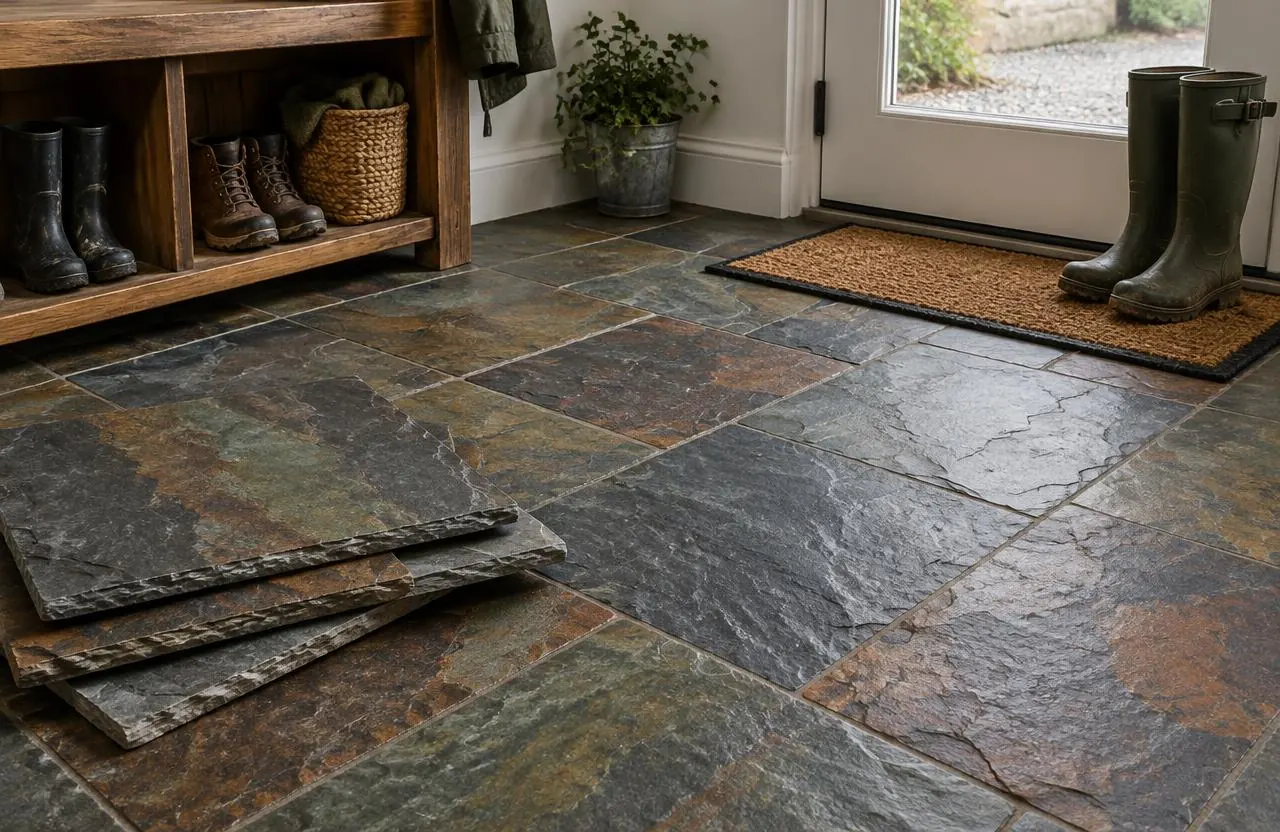
Cleft texture and natural variation
Slate splits along natural cleavage planes, leaving a textured “cleft” face. That texture gives good footing and hides dirt, but it also means tiles are not perfectly flat or uniform. Colour can range across charcoal, green, plum and rust within one shipment.
Before setting, tiles are opened from several boxes and blended. Very thin or weak pieces, and those that flake badly, are set aside. Some slates naturally shed small flakes at first; that is different from slate that delaminates in layers, which points to a poorer-quality stone.
Gauged or ungauged slate
Gauged (calibrated) slate has its back ground to a consistent thickness, so it can be set with a standard thin-set method over a flat substrate. Ungauged slate varies in thickness from tile to tile and needs a thicker medium-bed mortar or careful back-buttering to bring faces into plane.
Ask which you are buying. The choice changes the setting material, the labour and how flat the finished floor will feel underfoot.
Slate quality and interior or exterior rating
Slate quality varies by quarry. ASTM C629 classifies slate dimension stone for exterior use (maximum absorption 0.25%) and interior use (maximum 0.45%), with minimum strength values for each. For an unheated porch, exterior step or anything exposed to Ottawa freeze-thaw cycles and de-icing salt, use slate the supplier certifies for exterior use, on a substrate built to drain.
Request the supplier’s test data where it exists. Low-cost imported slate without data may perform well indoors and poorly outside.
Substrate and setting
Like other natural stone, slate needs a stiff floor; deflection that a porcelain floor tolerates can crack stone. A crack-isolation or uncoupling membrane is common over wood subfloors and cracked slabs. Movement joints are placed at perimeters and in larger fields.
Grout joints are often wider with cleft slate to absorb edge variation. Many installers apply a pre-grout sealer or grout release so grout does not lodge in the cleft texture.
Sealers, colour and cleaning
Many slate floors are sealed with a penetrating sealer to resist staining and make grout clean-up easier; some owners choose a colour-enhancing sealer that deepens the stone’s tones. Topical coatings that form a film can scuff and look patchy in traffic lanes. As with all stone, the need for sealing depends on the specific slate.
Day to day, sweep grit, then mop with a pH-neutral stone cleaner. Steam mops and harsh chemicals can damage sealers; check the sealer maker’s guidance before using one.
Slip resistance, thresholds and transitions
Cleft slate generally offers good grip, which suits entries and mudrooms. Its uneven surface does mean height changes at door thresholds, adjacent hardwood and stair nosings need planning — a transition profile or a carefully selected, flatter row of tiles at the edge.
Slate at an exterior door should stop at a threshold that sheds water away from the interior, not create a lip that traps meltwater.
What shapes slate flooring installation cost
Slate is priced on stone quality, calibration and preparation.
- Gauged or ungauged slate, and the setting method it requires
- Sorting and waste from variable tiles
- Floor stiffening, flattening and membranes
- Exterior work: drainage and exterior-rated stone
- Sealing before and after grouting
- Thresholds, transitions and stair edges
Common questions
Are slate floors expensive?
Slate ranges widely by source and calibration. Ungauged slate can cost less to buy but more to install. GCO prices after confirming the stone and the substrate.
Are slate floors outdated?
Style is personal. Slate remains practical for entries and mudrooms because of its texture and grip; colour and tile size change how modern or traditional it looks.
Can you refinish slate floors?
Slate is usually deep-cleaned, stripped of old coatings and resealed rather than refinished like wood. Badly damaged tiles can be replaced.
Can you steam clean slate floors?
Check the sealer maker’s guidance first; steam can damage some sealers and loosen weak grout. A pH-neutral stone cleaner and mop is the safer routine.
Can slate be used outdoors in Ottawa?
Only slate rated for exterior use, on a substrate that drains, with exterior-rated setting materials. Freeze-thaw and de-icing salts are hard on stone.
Does slate need sealing?
Many slate floors benefit from a penetrating sealer to resist stains and simplify grouting; the need depends on the stone.