
What makes porcelain different
Porcelain is a ceramic tile made from denser clays fired at higher temperatures. The Tile Council of North America defines it by water absorption of 0.5% or less, measured to ASTM C373. Some products are labelled porcelain without meeting that threshold; independent certification exists to address that.
Glazed porcelain carries its colour in the glaze; unglazed or through-body porcelain carries colour into the tile body, so chips show less. Glazed porcelain is usually easier to clean; unglazed porcelain may offer better slip resistance. The density that makes porcelain durable also makes it harder to cut and harder to bond, so setting materials must be suited to porcelain.
Large-format tile: flatness and lippage
Porcelain is where very large tiles live — 24 by 48 inches, panels and slabs. Large tiles cannot bend over a hump or bridge a dip. For tiles with at least one edge 15 inches or longer, ANSI A108.02 limits substrate variation to 1/8 inch in 10 feet and 1/16 inch in 2 feet from the required plane. Most existing floors need grinding, patching or self-levelling underlayment to get there.
Lippage — one tile edge sitting higher than its neighbour — is the visible result of a floor that was not flat enough, mortar coverage that was uneven, or tile warpage. Levelling clips help align edges during setting; they do not flatten a floor. Offset patterns are planned with the tile’s warpage in mind, often limiting the offset on long planks.
Mortar, coverage and back-buttering
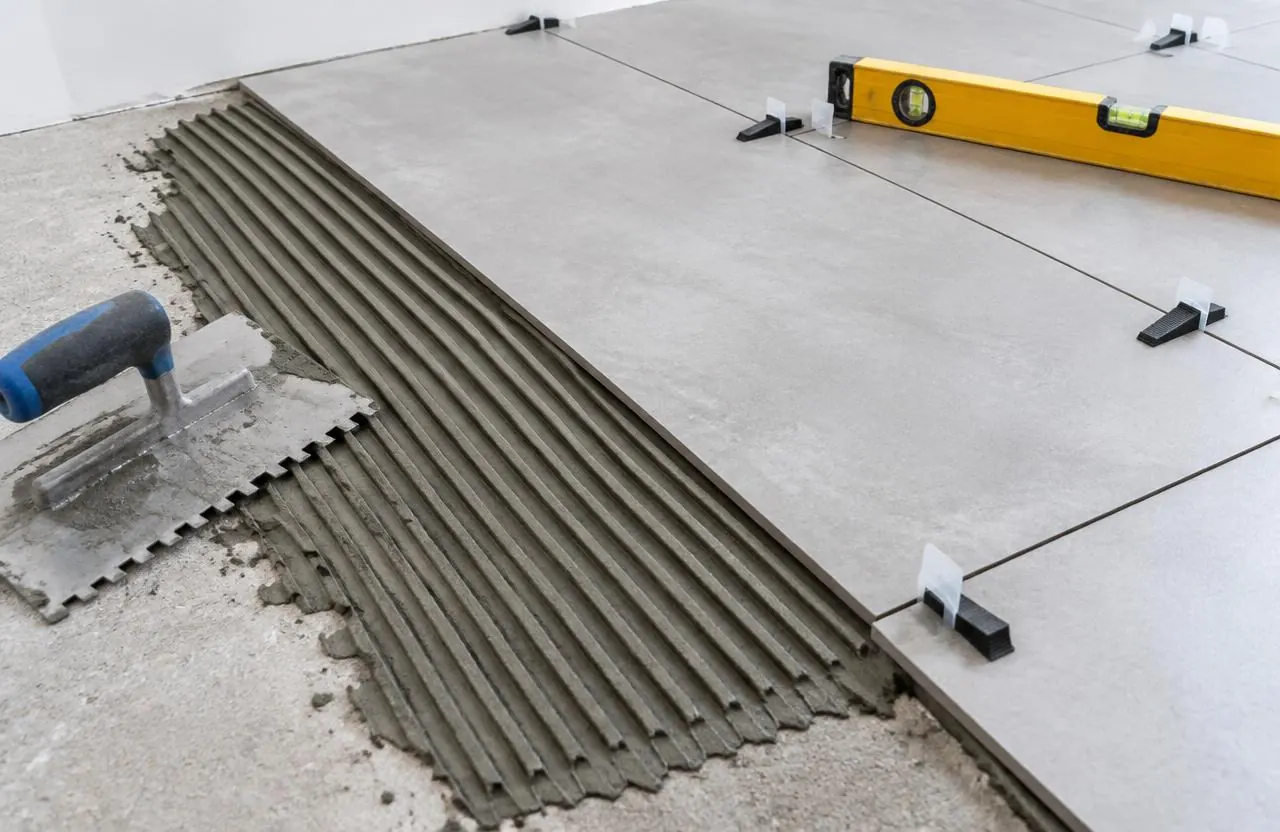
Large porcelain tiles need mortar rated for large and heavy tile, a trowel sized to the tile, and close to full contact underneath. Installers commonly comb mortar in straight lines and back-butter the tile so air can escape and coverage is complete. Hollow spots are where tile cracks under a chair leg or a dropped pot.
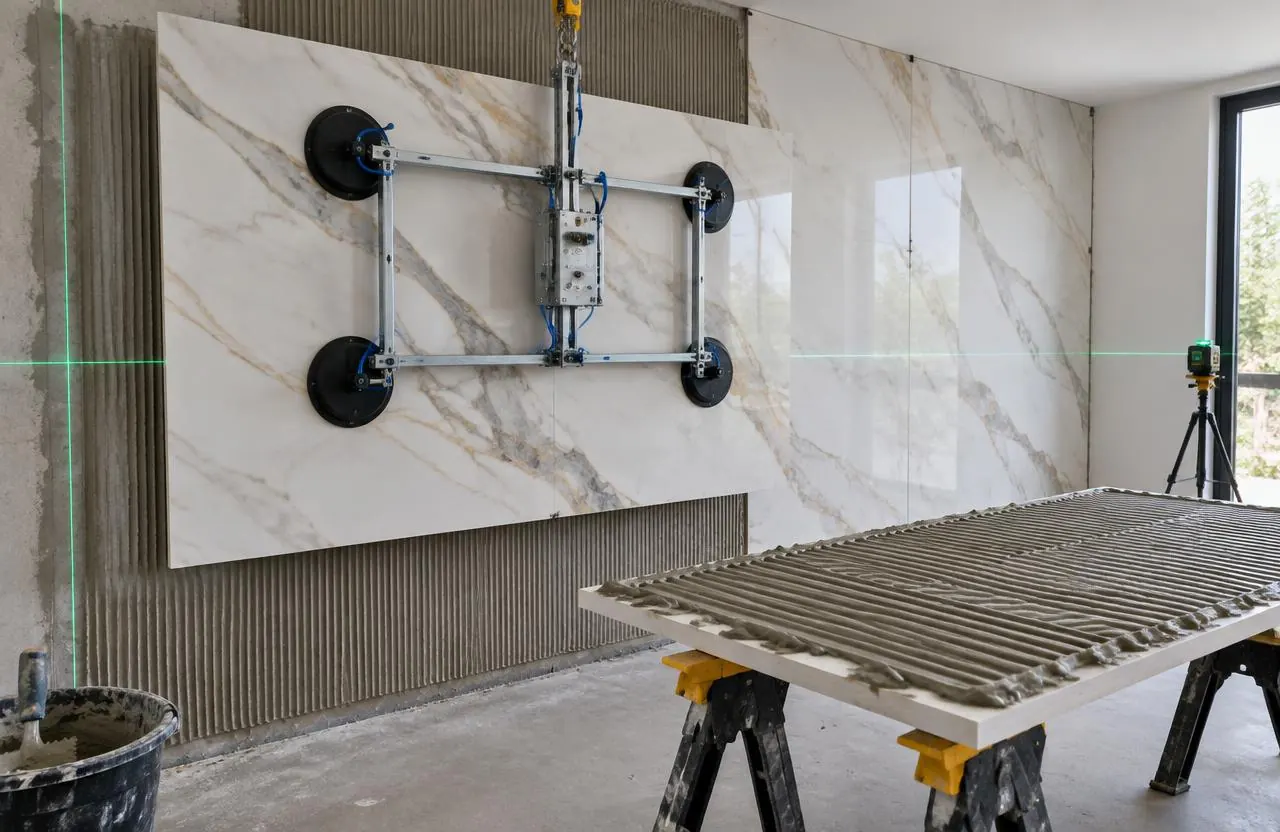
On walls, heavier tiles may need mortar with high sag resistance or temporary support, and very large panels need lifting frames and a two-person handling plan.
Layout, grout joints and movement
Rectified porcelain has precisely ground edges and allows narrower joints; pressed-edge tiles need wider joints to absorb size variation. “Can porcelain be installed without grout?” — no. Every tile installation needs grout joints, and large fields need movement joints at perimeters, changes of plane and at intervals in the floor so thermal and moisture movement does not crack or tent the tile.
Layout is drawn before setting: where cuts land at doors and walls, how lines align with cabinets or a shower, and how a heated floor or drain affects the pattern.
Porcelain outdoors and in entries
Low absorption makes porcelain the usual tile for Ottawa entries, mudrooms and some exterior applications — but TCNA notes that porcelain is usually, not always, frost resistant. For balconies, patios and steps, use tile the maker rates for freeze-thaw, a substrate built to drain, and setting materials rated for exterior use. Thicker porcelain pavers on pedestals or gravel are a separate system from thin tile bonded to concrete.
Indoors, entries see grit, road salt and meltwater all winter. Textured or matte porcelain with an appropriate wet slip-resistance rating, and a plan for boot trays and salt residue, keeps the floor safer and easier to clean.
What shapes porcelain tile installation cost
Large porcelain is often priced attractively per square foot; the labour and preparation are what scale.
- Floor or wall flattening: grinding, patching, self-levelling underlayment
- Tile size and weight: panels need special handling, tools and extra people
- Mortar type and coverage requirements for large tile
- Pattern and offset limits, and the amount of cutting
- Membranes for uncoupling, crack isolation or waterproofing
- Exterior work: drainage, frost-rated tile and exterior setting materials
- Edge profiles, stair nosings and transitions to other floors
Cleaning after installation and long-term care
After grouting, a thin cement haze can remain on porcelain. It is removed with the cleaner the grout and tile makers recommend once the grout has cured enough — not with harsh acids applied too early. Day to day, porcelain needs a pH-neutral cleaner; textured surfaces may need a soft brush.
Porcelain itself does not usually need sealing. Cement grout may, depending on the product.
Common questions
Can you install porcelain tile outside?
Only porcelain the maker rates for freeze-thaw exposure, over a substrate built to drain, with exterior-rated setting materials. Porcelain is usually but not always frost resistant.
Can you install porcelain tile without grout?
No. Tile needs grout joints sized for the tile’s edge tolerance and movement joints in larger fields. Rectified tile allows narrower joints, not none.
How much does it cost to install porcelain tile?
It depends mostly on preparation and tile size. Flattening the floor, membranes, panel handling, cutting and edge details often outweigh the tile itself. GCO prices after seeing the substrate.
How do you install large porcelain floor tiles?
On a floor flattened to large-format tolerances, with mortar rated for large tile, combed and back-buttered for near-full coverage, and a layout that respects the tile’s warpage. It is not a job to rush.
How do you clean porcelain tile after installation?
Remove grout haze with the cleaner the grout and tile makers recommend, once the grout has cured enough. Afterwards, a pH-neutral cleaner is enough for routine care.
Is porcelain better than ceramic?
For floors, showers and entries, porcelain’s density is usually an advantage. For walls and decorative tile, ceramic is easier to cut and offers more glaze options.