
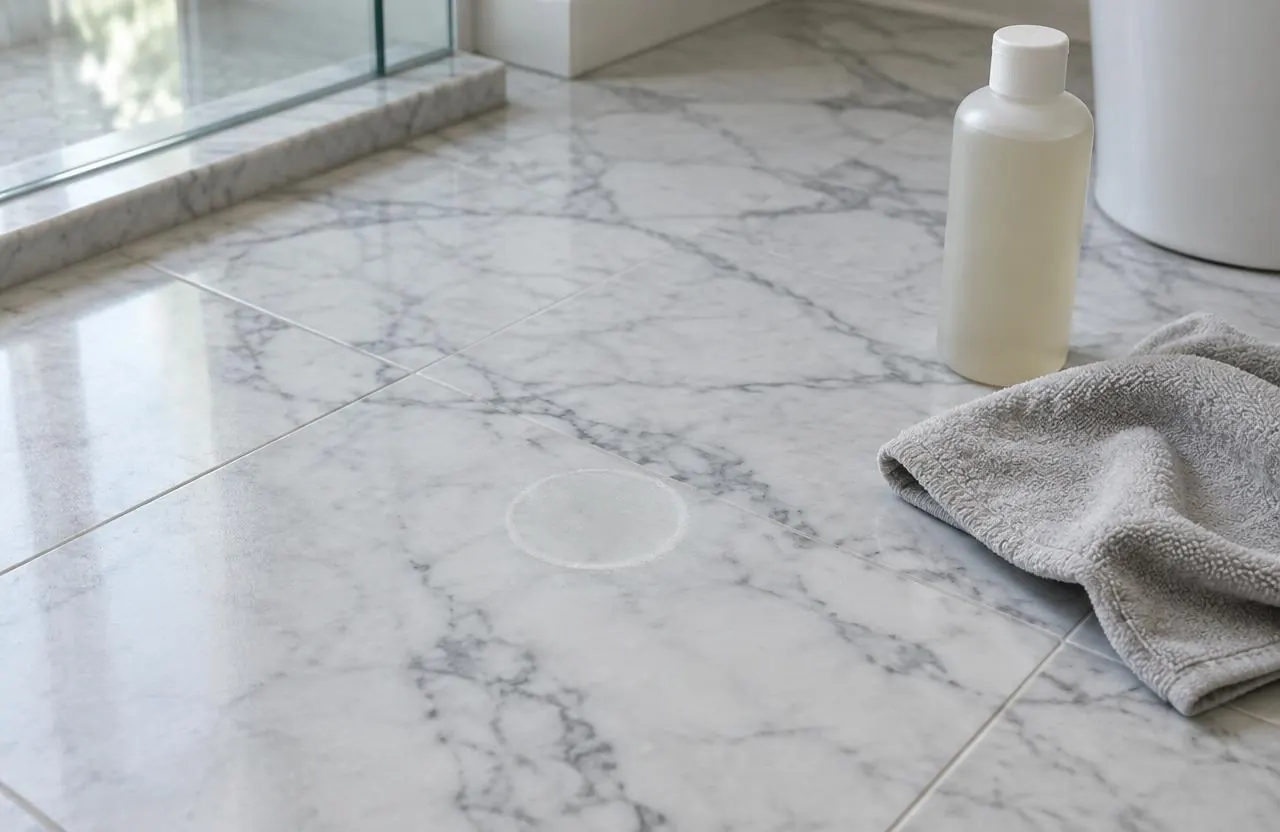
Etching versus staining
Marble reacts chemically with acids. A splash of citrus, vinegar, wine or an acidic cleaner leaves a dull, slightly rough mark called an etch. That is surface damage, not a stain, and no sealer stops it; etches are removed by honing and re-polishing.
Staining is different: a liquid soaks into the stone and leaves colour. Penetrating sealers reduce how quickly that happens. Quartzite, by contrast, does not etch from kitchen acids — one way stone professionals tell true quartzite from marble sold under a quartzite name.
Absorption and sealing
Marble is a relatively dense stone — ASTM C503 sets a maximum absorption of 0.20% for marble dimension stone — but density varies by quarry and polished stone absorbs differently from honed. The Natural Stone Institute’s position is that sealing makes sense for many marble and granite surfaces with a quality penetrating sealer, while noting that need varies.
Rather than a fixed annual schedule, test the installed stone: if water darkens it within a few minutes, it is absorbing and may benefit from sealing. Grout joints are sealed according to the grout maker.
Substrate and setting method
Natural stone tile is less forgiving of floor deflection than porcelain. Industry guidance calls for stiffer floor framing under natural stone than under ceramic, and a crack-isolation or uncoupling layer is common. Large marble tiles also need the same flatness and mortar coverage as large porcelain.
Light-coloured marble can show the setting material through it, so white mortar is used. Some marbles — particularly certain green and some dark stones — are moisture-sensitive and can warp or curl when set with ordinary water-based mortar; they need rapid-setting or epoxy setting materials specified by the stone supplier. Identifying the stone before ordering setting materials prevents those failures.
Marble in bathrooms and showers
Marble is widely used on bathroom floors and shower walls. It works best when the waterproofing is behind the stone, the shower floor uses small mosaics or honed tile for footing, and the cleaning routine avoids acidic and bleach-based products. Soap scum and hard-water deposits are often cleaned with acidic products — those will etch marble, so a stone-safe cleaner and daily squeegee are part of living with it.
Polished marble on a floor that gets wet is slippery. Honed, brushed or tumbled finishes and smaller formats give more grip; slip-resistance data from the supplier helps compare options.
Selection, variation and layout
Marble veining and colour vary from tile to tile and lot to lot. Order enough from one lot for the whole job plus cuts and spares, open boxes and lay out tiles dry to distribute veins before setting. Book-matched or veined layouts take more planning and more waste.
Marble cuts cleanly with a wet tile saw and diamond blade; edges are eased or polished where they show.
What shapes marble tile installation cost
Marble jobs are priced on stone type, preparation and how carefully the layout must be controlled.
- Stone type, finish and tile size
- Floor stiffening, flattening and uncoupling or crack-isolation membranes
- Setting materials for moisture-sensitive stones
- Vein matching, borders and mosaic work
- Waterproofing for showers and wet areas
- Edge finishing, thresholds and sealing
Cleaning and care
Use a pH-neutral cleaner made for natural stone. Avoid vinegar, citrus, bleach and abrasive powders. Wipe spills quickly, use mats at entries to keep grit off polished floors, and plan for occasional professional honing if etching builds up in daily-use areas.
Common questions
Do marble tiles need sealing?
Often, but it depends on the stone and finish. A water test on the installed tile shows whether it is absorbing. Sealing reduces staining; it does not prevent etching.
Can marble tile be used in a shower?
Yes, over a proper waterproofing assembly, with a stone-safe cleaning routine. Use smaller or honed tiles on the shower floor for grip.
How do you clean marble tile in a shower?
Use a pH-neutral stone cleaner and squeegee after use. Avoid acidic and bleach-based bathroom cleaners, which etch or damage marble.
Can I use bleach on marble tile?
It is best avoided. Harsh chemicals can damage the stone surface and any sealer. Use products labelled safe for natural stone.
Are marble tiles expensive?
Marble ranges widely by stone and finish. Installation cost also reflects floor preparation, setting materials, layout and waterproofing, which GCO prices after assessing the space.
Why does my marble have dull spots?
Those are usually etches from acids. They are surface damage, not stains, and are removed by honing and polishing.