
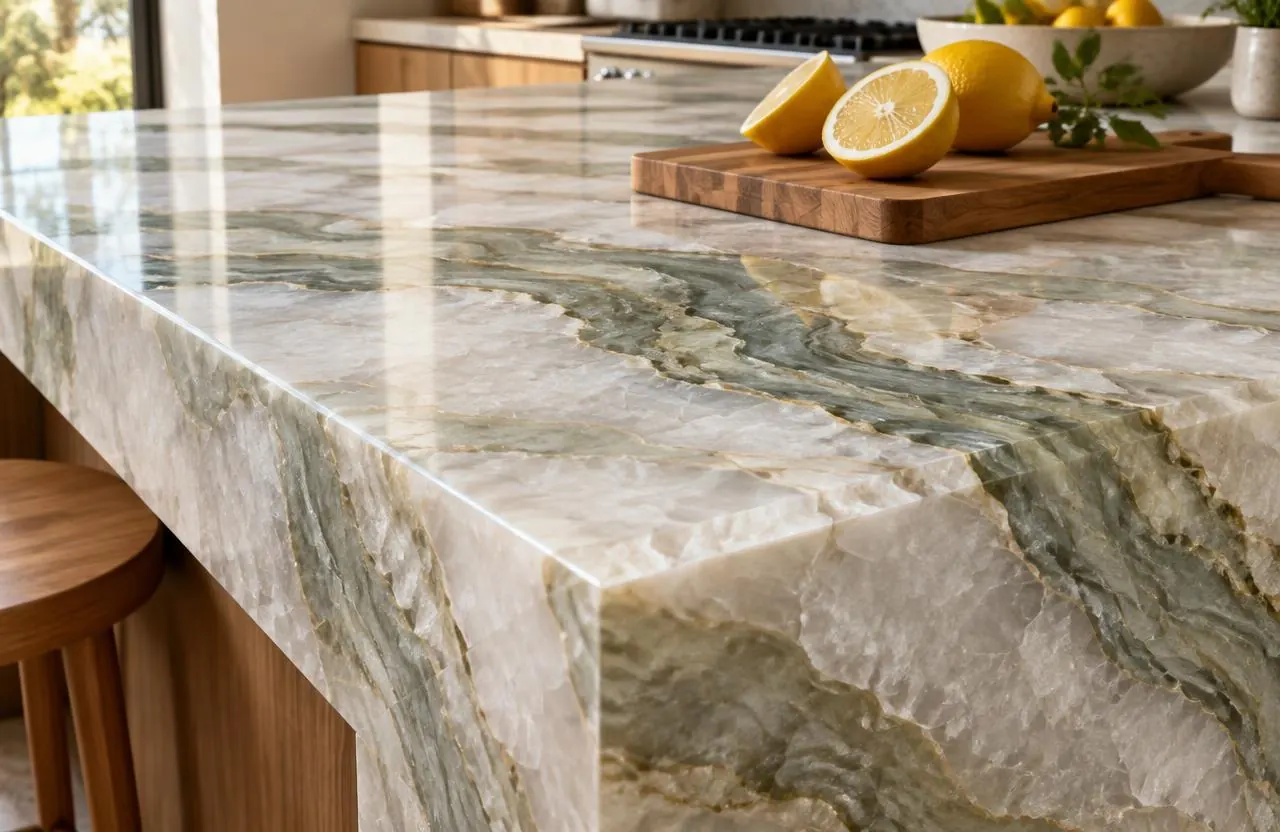
Quartzite versus engineered quartz
“Quartz vs quartzite” is one of the most-searched countertop comparisons. Quartzite is quarried natural stone with marble-like veining and the variation of any natural slab. Quartz countertops are manufactured from quartz aggregate and resin to a consistent design.
Quartzite generally tolerates heat better than resin-bound quartz and, where rated, is used outdoors. Quartz is uniform and needs no sealing. Both are hard; quartzite can be hard enough to dull knives, so cutting boards are as much for the knives as the stone.
| Quartzite | Engineered quartz | |
|---|---|---|
| Origin | Natural, quarried | Manufactured |
| Look | Unique veining and translucency | Consistent, designed pattern |
| Heat | Heat tolerant; trivets advised | Resin can be damaged; trivets required |
| Etching from acids | True quartzite resists it | Resistant |
| Sealing | Depends on porosity | Not required |
| Fabrication | Very hard; slower to cut and polish | Consistent fabrication |
Identifying true quartzite
Some stones are sold as quartzite or “soft quartzite” when they are marble or dolomitic marble. They look similar and behave differently: marble etches with lemon juice and vinegar, quartzite does not. Use Natural Stone describes simple checks: true quartzite scratches glass, is not easily scratched by a knife blade and does not etch with lemon juice.
Ask the supplier for a sample of the actual stone and test it before committing, particularly with white and light-coloured stones marketed as low-maintenance.
Slab selection and layout
Quartzite veining can be dramatic and directional. Choose slabs in person where possible, consider book-matched slabs for islands and backsplashes, and review the cutting layout so veins flow across seams and down waterfall ends. Translucent quartzites can show their structure when backlit; that is a design choice to make early.
Porosity and sealing
Quartzite forms from sandstone, and how completely it recrystallised affects how porous it is. Dense quartzites may not need sealing; more porous varieties benefit from an impregnating sealer at installation and at intervals afterwards. Watching for darkening around the sink is a practical sign that sealing is due.
The fabricator or supplier should recommend a sealer for your specific stone. A water test on the installed top confirms whether it is absorbing.
Fabrication
Quartzite’s hardness makes it slower and more demanding to cut, edge and polish than many granites or quartz. Mitred edges, waterfall ends and thin profiles need careful fabrication. ASTM C616 groups quartzite with quartz-based dimension stone; the densest class has very low absorption, but slabs vary.
What shapes quartzite countertop cost
Quartzite is often priced above many granites and quartz products, mainly because of slab cost and fabrication time.
- Stone type and slab selection
- Book-matching and vein alignment
- Edge profile, mitred and waterfall details
- Cut-outs and polishing
- Supports, removal of old tops and plumbing reconnection
- Sealing at installation where the stone needs it
Cleaning and care
Care is similar to granite: wipe with a gentle cleanser, water and a soft cloth, wipe spills promptly, and use trivets, coasters and cutting boards. Avoid harsh chemicals that can degrade a sealer.
Common questions
What are quartzite countertops?
Countertops cut from quartzite, a natural metamorphic stone formed from quartz-rich sandstone. They look similar to marble and are much harder.
What is the difference between quartz and quartzite?
Quartzite is natural stone; quartz countertops are engineered from quartz and resin. Quartzite varies slab to slab and tolerates heat better; quartz is consistent and needs no sealing.
Are quartzite countertops expensive?
They are often priced above many granites and quartz products because of slab cost and slower fabrication. GCO prices from the actual slab and layout.
Are quartzite countertops heat resistant?
True quartzite is heat tolerant. Trivets are still advised to protect any sealer and avoid thermal shock.
Does quartzite need sealing?
It depends on the stone’s porosity. Some quartzites need none; porous varieties benefit from sealing at installation and periodically.
How can I tell if my stone is really quartzite?
True quartzite scratches glass, resists a knife blade and does not etch with lemon juice. Test a sample of the actual stone before buying.