
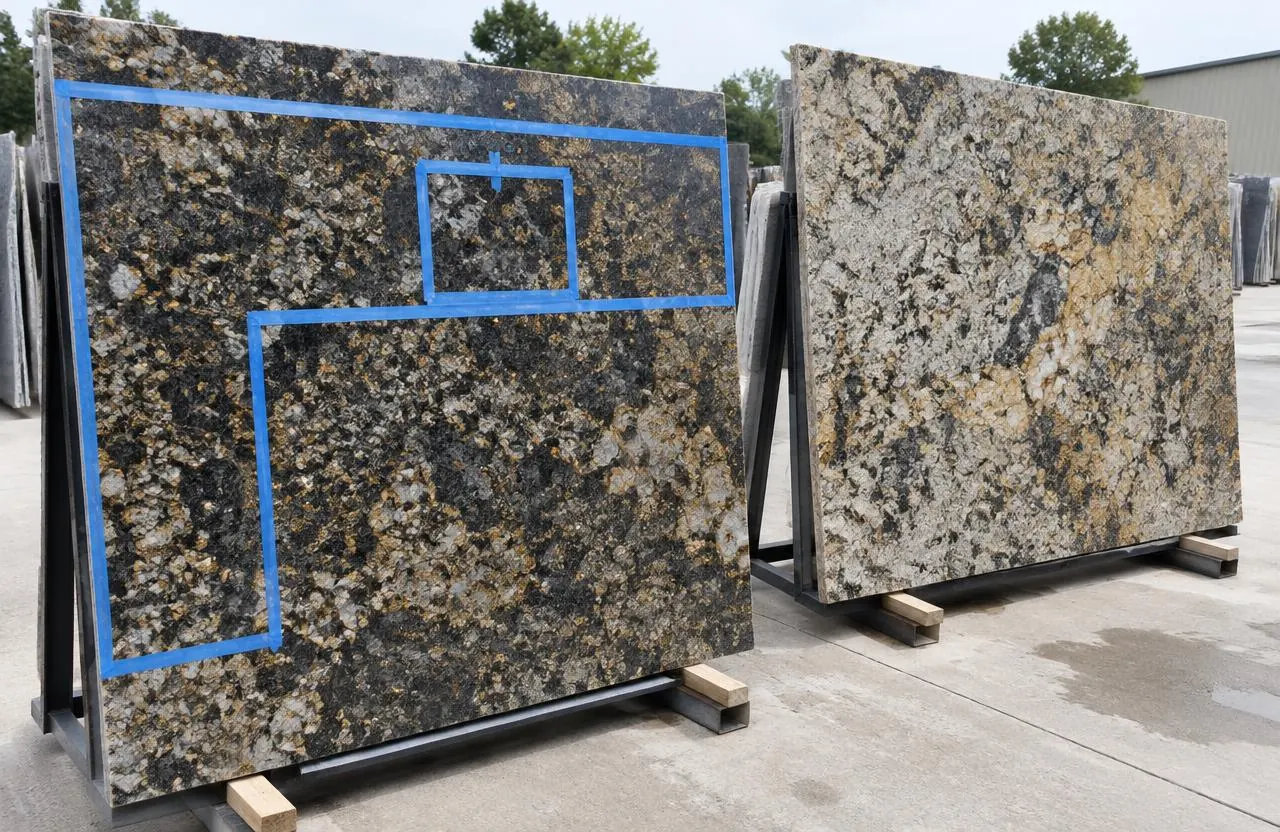
Natural variation and slab selection
Two slabs with the same trade name can look quite different. Granite colour and pattern shift within a slab, between slabs from the same block and between shipments. If consistency matters, choose slabs cut sequentially from one block and view them in person.
Look for natural features — fissures, pitting, colour clusters — and decide whether you like them. Many are normal characteristics, not defects. Some slabs are treated with resin at the factory to fill micro-fissures; ask whether yours has been.
Layout on the slab
Where the countertop pieces are cut from each slab decides what you see: whether a dramatic movement runs along the island, where a colour cluster lands, how patterns meet at a seam. Fabricators can show a digital or taped layout on the slabs before cutting. It is worth a visit for bold or flowing granites.
Support, seams and overhangs
Granite is heavy. Cabinets must be level, fastened and sound, and spans over dishwashers or open sections supported. Seating overhangs beyond the fabricator’s limit need concealed brackets or steel supports.
Seams depend on slab size and layout and are placed over support, away from sinks and cooktops where possible. In busy granite patterns, a well-made seam is hard to spot; in calm or directional patterns, matching flow across the seam takes planning.
Sealing: decided per slab
The Natural Stone Institute’s position is that most granite countertops do not need to be sealed, though many benefit from a quality penetrating sealer that further reduces moisture and oil absorption. That means there is no universal annual schedule. A simple water test — a few drops left for several minutes — shows whether the slab darkens and is absorbing.
If your stone does benefit from sealing, use an impregnating sealer suited to the stone and follow its maker’s reapplication guidance. Resin-treated slabs often need little.
Granite durability
Granite is dense: ASTM C615 sets a maximum absorption of 0.40% for granite dimension stone. It is generally heat tolerant and resists kitchen acids, but it can chip at edges and corners, and sudden extreme heat in one spot can stress any stone. Trivets and cutting boards remain good practice.
What shapes granite countertop cost
Granite pricing varies widely by stone and fabrication.
- Stone type, grade and slab availability
- Number of slabs, area and seams
- Edge profile and thickness
- Cut-outs for sink, cooktop and faucets
- Supports for overhangs and islands
- Removal of old tops, backsplash and plumbing reconnection
- Access and handling of heavy pieces
Cleaning and care
Clean granite with warm water and a mild pH-neutral soap or stone cleaner. Avoid abrasive pads and harsh chemicals that can degrade a sealer. Wipe oils and spills promptly; watch the area around the sink for darkening, which can indicate absorption.
Common questions
How do I seal granite countertops?
First test whether it needs it: if water darkens the stone within several minutes, it is absorbing. Clean and dry the surface, then apply an impregnating sealer suited to the stone per its instructions. Many granites need little or no sealing.
How do you clean granite countertops?
Warm water with a mild pH-neutral soap or stone cleaner and a soft cloth. Avoid abrasive pads and harsh chemicals.
Does granite need to be sealed every year?
Not necessarily. Sealing needs depend on the slab; the Natural Stone Institute notes most granite countertops do not need sealing. A water test is a better guide than a calendar.
Can I choose my exact granite slab?
Usually, through the fabricator or stone supplier. Choosing the slab and reviewing the layout is recommended for natural stone.
Can granite crack?
It can if cabinets are uneven, overhangs are unsupported or it is struck at an edge. Proper support and installation prevent most problems.
Is granite heat resistant?
Generally, yes, more than engineered quartz. Trivets are still advised to protect the stone, any sealer and the edges.