
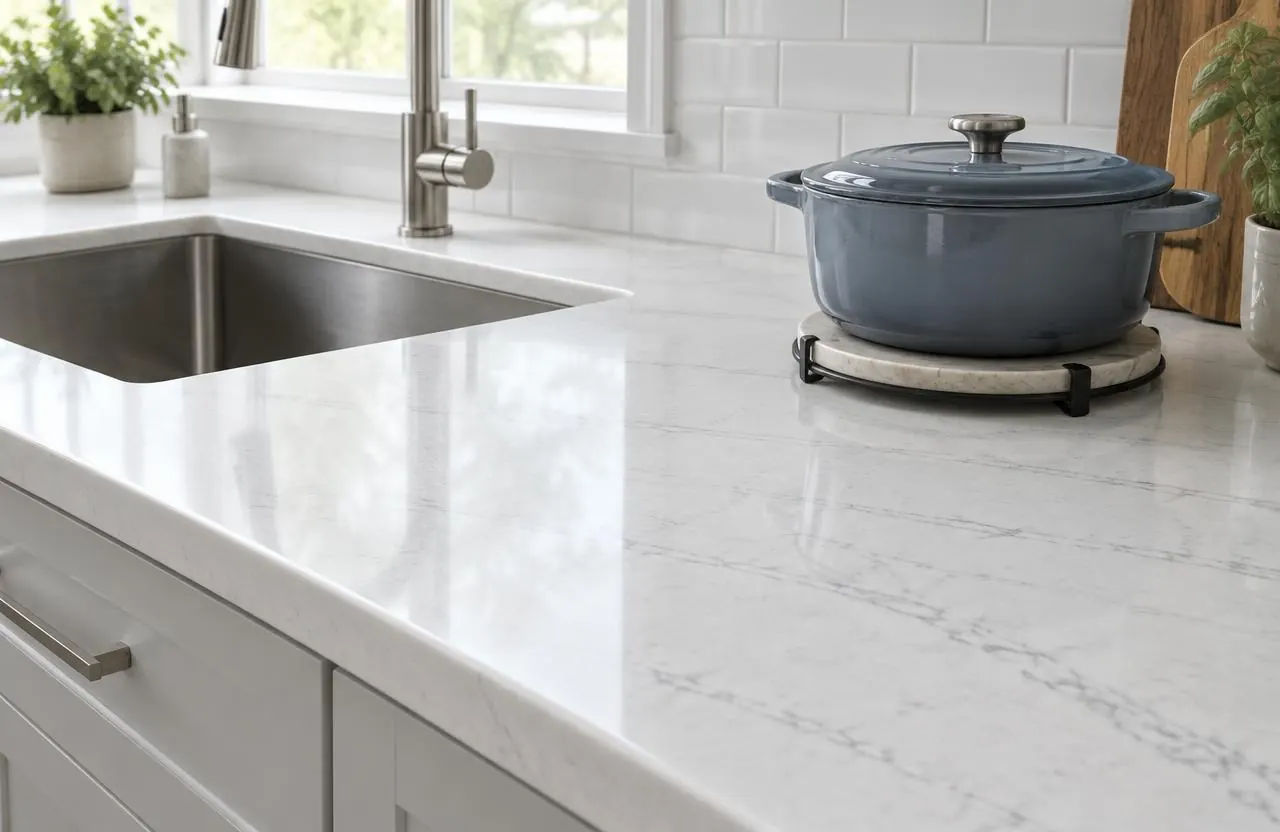
Engineered quartz versus quartzite
The names are confusingly close. Quartz countertops are manufactured; quartzite is quarried. Quartz slabs look consistent and can be ordered to match; quartzite slabs are natural and unique. Quartz needs no sealing; some quartzites do. Quartz makers’ care guides commonly call for trivets under hot items, while true quartzite is generally more heat tolerant.
If you like the look of marble but want low maintenance, both are candidates for different reasons: quartz for predictability, quartzite for natural stone character with good etch resistance. The quartzite page explains that side.
Finish and slab appearance
Polished quartz reflects light and shows fewer fingerprints on lighter colours; matte, honed and textured finishes look softer but can show marks and oils more and may need more frequent wiping. Patterns range from solid colours to marble-look veining. On veined designs, ask how veins continue across seams and on mitred edges — some products are designed for it, others are not.
Look at full slabs or large samples in daylight. Small chips do not show how a vein or pattern repeats across an island.
Seams, edges and sinks
Quartz slab sizes set where seams fall; long islands may fit one jumbo slab or need a seam. Colour-matched seams are less visible on solid and speckled patterns than on bold veining.
Edge profiles range from eased square to bevelled, bullnose and mitred edges that make a top look thicker. Undermount sinks suit quartz well; the cut-out is polished and the sink attached by the fabricator. Plan faucet holes, soap dispensers and any instant hot water tap before templating.
Heat, sunlight and product-specific limits
Care rules are product-specific. Caesarstone’s Canadian care manual, for example, recommends a trivet under hot items on its quartz surfaces and says not to allow direct contact with a naked flame — while allowing hot cookware directly on its porcelain, a different material with different instructions. A guide applies only to its maker’s own products, so follow the one for the product you buy.
Indoor and outdoor suitability is also set by each manufacturer. For an outdoor kitchen or a sunny sunroom counter, ask for the product’s written exterior or UV rating rather than assuming. Each manufacturer publishes its own care and warranty terms; GCO has no affiliation with the manufacturer cited here and does not add to or extend those terms.
Fabrication and safety
Quartz is cut and polished by a fabricator, who also attaches undermount sinks. The Canadian Centre for Occupational Health and Safety notes that engineered stone can contain up to 90 to 97% silica — far more than granite or marble — and that cutting, drilling, grinding and polishing can release silica dust linked to silicosis, lung disease and lung cancer. The controls it lists include wet methods, local exhaust ventilation, HEPA tool attachments and, where needed, respiratory protection.
That is why most fabrication happens in the fabricator’s shop, any on-site cutting is kept to a minimum and done with dust controls, and homeowners should not cut or grind quartz themselves.
What shapes quartz countertop cost
Quartz pricing depends on the product group and the fabrication.
- Product line and pattern
- Slab count, total area and seams
- Edge profile and mitred or waterfall ends
- Sink and cooktop cut-outs and faucet holes
- Removal of old tops and backsplash
- Plumbing reconnection where there is a sink, and access
Cleaning and care
“How do you clean quartz countertops?” is among the most-searched countertop questions in Canada. Caesarstone’s Canadian manual, for its quartz, recommends warm soapy water or a mild detergent with a clean damp cloth, then drying the surface; it says not to use hydrofluoric acid or oil-based cleaning or polishing products, and to use a cutting board rather than cutting on quartz. Other manufacturers publish their own lists, so check the guide for your product. Quartz is low-maintenance, not maintenance-free.
Common questions
How much are quartz countertops?
Cost depends on the product line, area, number of slabs, edges, cut-outs, removal and plumbing. GCO prices from the template layout rather than a per-square-foot estimate in advance.
How do you clean quartz countertops?
Warm soapy water or a mild detergent and a soft damp cloth, then dry it. Avoid anything your product’s care guide excludes — Caesarstone’s, for example, excludes hydrofluoric acid and oil-based cleaners.
Is quartz the same as quartzite?
No. Quartz countertops are engineered from quartz and resin; quartzite is a natural stone. They differ in appearance, fabrication and care.
Can you put hot pans on quartz?
Follow your product’s care guide. Caesarstone, for example, recommends a trivet under hot items on its quartz; other makers set their own rules.
Does quartz need sealing?
No. Engineered quartz is non-porous and does not need sealing.
Can quartz be used outdoors?
Only where the manufacturer rates the specific product for exterior use. Ask for that rating in writing before choosing it for an outdoor or very sunny location.