
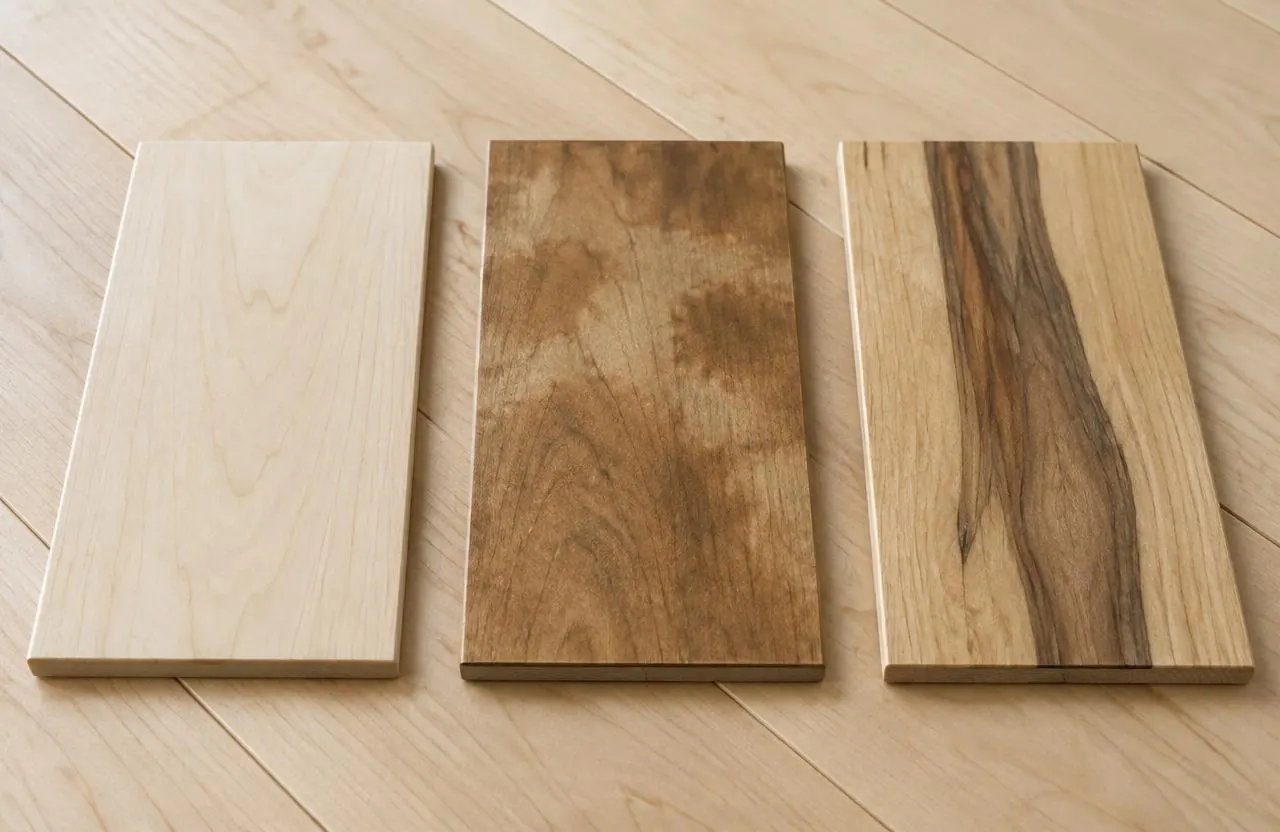
Hard maple: what you are choosing
Maple flooring is normally hard maple — sugar or black maple — a dense North American hardwood. Manufacturer data puts hard maple at about 1,450 lbf on the Janka hardness scale. Some floors are sold as maple without naming the species; silver and red maple are softer and much less impact-resistant, so ask which species you are buying.
Maple has a closed, fine grain that reads smooth and calm. Sapwood is pale cream; heartwood is reddish-brown and can be quite dark. Light exposure changes maple’s colour over time, which factory UV-inhibiting finishes slow but do not stop.
Maple or oak?
Oak is the most common hardwood in Ottawa homes; maple is the choice for a lighter, quieter look. The practical differences are grain, stain behaviour and how wear shows.
| Hard maple | Red oak | White oak | |
|---|---|---|---|
| Grain | Closed, fine, even | Open; cathedral grain when plain-sawn | Open, longer rays; quarter-sawn shows pronounced ray fleck, rift-sawn straight grain with little figure |
| Colour | Cream sapwood, reddish heartwood | Warm, pink-red undertones | Neutral tan to grey-brown |
| Janka (approx.) | 1,450 lbf | 1,290 lbf | 1,360 lbf |
| Stain | Can blotch, especially in darker colours; test first | Pink-red undertones affect colour; test first | Neutral base; test the chosen stain and finish |
| Shows wear | Marks and dents more visible on pale surface | Grain hides wear well | Grain hides wear well |
Grades, colour variation and samples
Maple grades sort boards by colour and character. Select or clear grades limit heartwood and mineral streaks for a uniform pale floor; character or natural grades include more heartwood colour, mineral streaks and figure. Neither is better — they look very different across a room.
Look at a large sample or several full boards in your own light, ideally with the finish you plan, before ordering. Small samples rarely show the range of colour that will appear across an entire floor.
Stain on maple
Maple’s dense, closed grain can absorb stain unevenly, producing blotches — especially with darker colours. Many maple floors are finished natural or bought factory-finished in a colour the manufacturer has controlled. If you want a site-stained colour, a test area on the actual boards, sanded the same way as the floor, is essential. Some colours are achieved with conditioners or dye-based systems; your finisher should show you the result first.
Solid or engineered maple
Solid maple strip suits main and upper floors over a wood subfloor and can be sanded several times. Engineered maple puts a maple wear layer on a stable core, making wider boards and installation over concrete or below grade practical where the product allows.
For engineered maple, whether it can be refinished depends on the remaining wear layer, previous sanding, texture and the manufacturer’s guidance. The engineered hardwood page explains what to check.
Moisture, subfloor and installation
Like other hardwoods, maple shrinks in dry heated winters and swells in humid summers, and its pale surface makes seasonal gaps easy to see. The NWFA guidelines call for checking jobsite conditions, the wood’s moisture content and the subfloor before installation; maple is then acclimated as its manufacturer specifies.
Dense maple strips are typically nailed with fasteners the manufacturer approves — the wrong staples can split the tongue or the face. Subfloor flatness and fastening are corrected first so the floor stays quiet.
What shapes maple flooring installation cost
Maple projects are priced on grade, format and preparation.
- Grade and colour selection
- Solid strip or engineered plank, and wear-layer thickness
- Prefinished or site-finished, and any stain testing
- Subfloor preparation and removal of the old floor
- Stairs, nosings and transitions
- Trim and baseboards
Finish care
Matte and satin finishes make marks less noticeable on pale maple. Use felt pads, mats at entries and the cleaner your finish maker approves. Keep indoor humidity within the manufacturer’s range to limit gaps. When the finish wears, a screen and recoat can refresh it before full sanding is needed.
Common questions
Is maple a good hardwood for floors?
Yes. Hard maple is dense and even-grained and wears well in homes. It suits people who want a pale, smooth floor and accept that marks show more than on oak.
Is maple hardwood flooring durable?
Hard maple is harder than red oak by Janka rating. Its finish still takes scratches, and dents and marks are more visible on its light colour.
Can you stain maple hardwood floors?
Yes, but maple can blotch, especially in darker colours. Test on the actual boards first, or choose a factory-finished colour.
How do you refinish maple hardwood floors?
Solid maple is sanded and refinished like other hardwoods, with extra care on stain. Engineered maple depends on its wear layer. Many worn finishes only need a screen and recoat.
How do you clean maple hardwood floors?
Sweep or vacuum grit and use the cleaner your finish maker approves. Avoid wet mopping and steam.
How much is maple hardwood flooring?
Price depends on grade, format and finish, plus preparation, stairs and trim. GCO provides a written proposal after assessing the floor.