
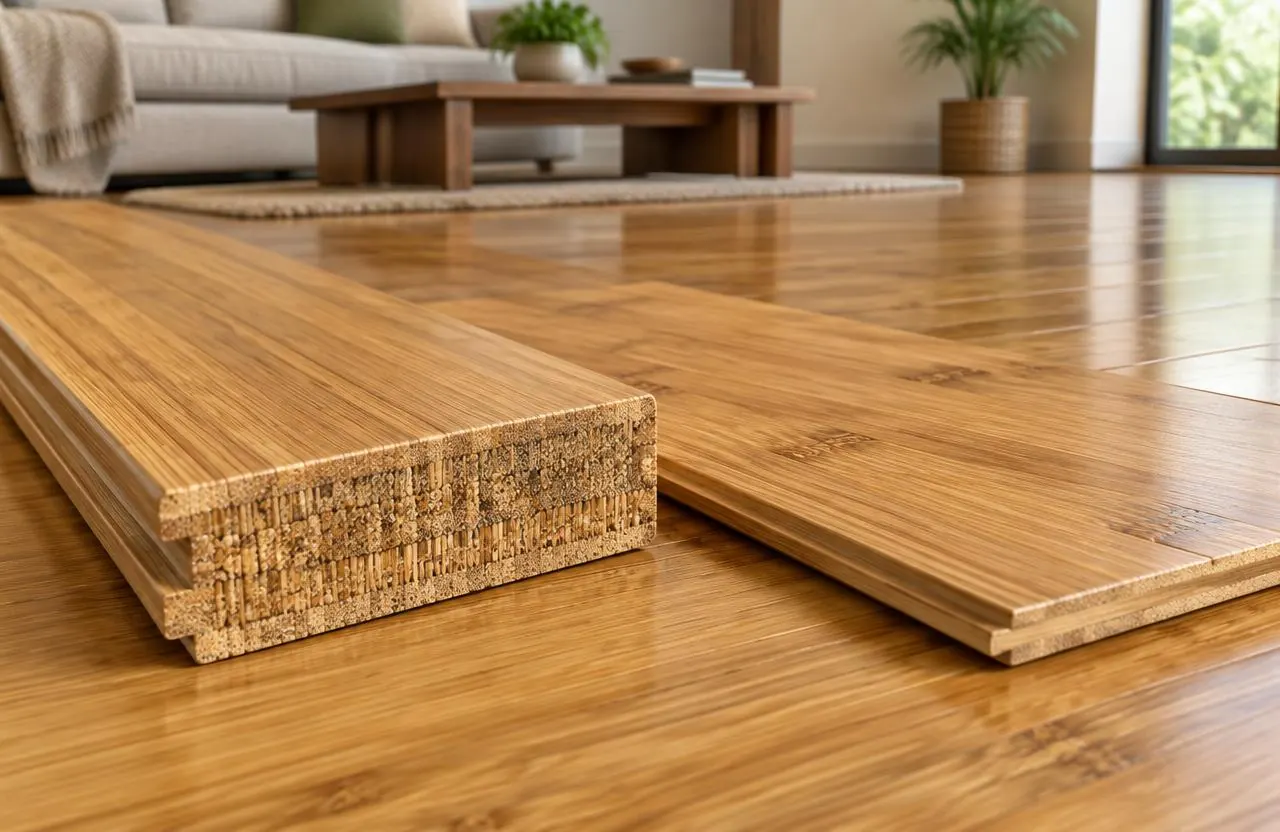
How bamboo flooring is made
Bamboo is a grass, not a tree, so there are no bamboo boards to saw. Stalks are split into strips or shredded into fibres, dried, treated and bonded together under pressure with adhesive. How that happens determines the floor.
Horizontal bamboo lays strips flat and shows the bamboo nodes; vertical bamboo stands strips on edge for a finer, striped look. Strand-woven bamboo compresses shredded fibres into a dense block and cuts boards from it, producing a much harder, more wood-like grain. Engineered and click bamboo bond a bamboo face to a plywood, fibreboard or other core.
| Construction | Appearance | Considerations |
|---|---|---|
| Horizontal strip | Wide strips with visible nodes | Softer than strand-woven; dents more easily |
| Vertical strip | Narrow, uniform stripes | Similar hardness to horizontal; consistent look |
| Strand-woven | Wood-like grain, often darker | Very dense; heavy; can be sensitive to humidity swings if not acclimated and installed as specified |
| Engineered / click | Any of the above as a face layer | Core and top-layer thickness decide stability, installation method and refinishing |
Moisture, acclimation and Ottawa’s seasons
Bamboo is a plant fibre and moves with humidity like wood. Dry, heated Ottawa winters can open gaps; humid summers can cause swelling and cupping, especially with dense strand-woven boards installed without enough expansion space. Manufacturers set acclimation steps, moisture limits for the bamboo and subfloor, and an indoor humidity range to maintain.
Before installation, GCO measures the subfloor and, over concrete, tests the slab, then follows the product’s instructions for acclimation and moisture protection. Bamboo is generally not a wet-room floor.
Product guides show how specific those rules are. One manufacturer’s solid bamboo guide, for example, limits those floors to on- or above-grade installation, while the same company’s engineered bamboo guide allows above, on or below grade and recommends glue-down below grade. Both call for subfloor moisture testing and a moisture meter suitable for bamboo. These are one maker’s rules for its own products, not universal limits; the installation follows the instructions and moisture-control system for the product you choose.
Installation methods
Solid and strand-woven bamboo is commonly nailed or stapled to a wood subfloor or glued down; the maker specifies fasteners because dense strand-woven boards can split with the wrong ones. Engineered and click bamboo can often float over underlayment or be glued to concrete.
Expansion gaps at walls, transitions and fixed objects matter more than usual for dense bamboo. Long runs and large open rooms may need breaks the manufacturer requires.
Durability, finish and refinishing limits
Strand-woven bamboo is harder than most domestic hardwoods by common measures, but hardness is not scratch-proofing: the factory finish takes the scratches. Horizontal and vertical bamboo are softer and dent more easily.
“Can bamboo floors be sanded and refinished?” depends on the construction. Solid bamboo with enough material above the tongue can usually be sanded; engineered and click products depend on the bamboo face thickness, and some cannot be sanded at all. Many factory finishes can be screened and recoated rather than sanded. Check the product’s refinishing guidance before buying if long-term refinishing matters to you.
Environmental claims
Bamboo grows quickly, which is why it is often marketed as an environmental choice. The finished floor’s footprint also depends on adhesives, processing, shipping and how long it lasts. Rather than relying on general marketing claims, look for product-specific certifications and emission test results on the product you choose.
What shapes bamboo flooring installation cost
Bamboo pricing reflects the product construction and the floor it goes over.
- Construction: strand-woven, horizontal, vertical or engineered/click
- Removal of the old floor and subfloor repair
- Moisture testing and any vapour control over concrete
- Installation method: nail, glue or float
- Stairs, nosings and transitions
- Baseboards and trim reinstated after installation
Cleaning and care
“How do you clean bamboo flooring?” is one of the most-searched bamboo questions. Sweep or vacuum grit, then damp-mop with the cleaner the manufacturer recommends — not a soaking-wet mop, steam mop or oil soap unless the maker approves it. Felt pads, entry mats and humidity control in winter protect the floor more than any cleaner.
Common questions
What is bamboo flooring?
A manufactured floor made from bamboo grass, split or shredded and bonded into boards or into a top layer over a core. It looks and installs much like wood flooring.
Are bamboo floors durable?
Strand-woven bamboo is very dense and resists dents well; horizontal and vertical bamboo are softer. All bamboo depends on its finish for scratch resistance and on humidity control for stability.
Can bamboo floors be sanded and refinished?
Solid bamboo usually can. Engineered and click products depend on the thickness of the bamboo face, and some cannot be sanded. Many can be screened and recoated instead.
How do you clean bamboo flooring?
Sweep or vacuum, then damp-mop with the manufacturer’s recommended cleaner. Avoid excess water and steam mops unless the maker approves them.
Are bamboo floors expensive?
Bamboo spans a wide range by construction and brand. Installation cost depends more on preparation, method, stairs and trim than on the material category.
Can bamboo flooring go in a basement?
Only a product its manufacturer approves for below grade, over a slab that passes the specified moisture tests and with the moisture-control system that manufacturer requires. Some makers limit solid bamboo to on- or above-grade rooms, so check the exact product’s instructions.