
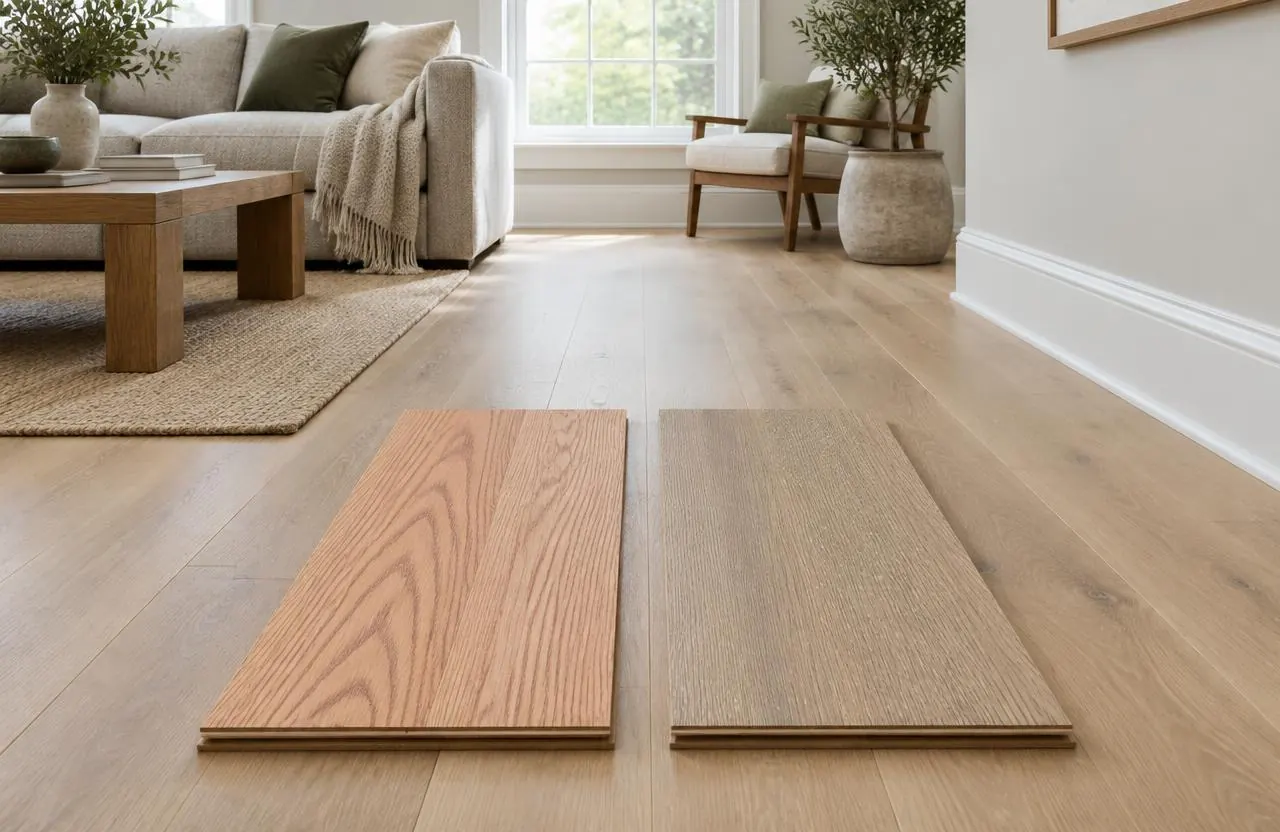
Red oak or white oak?
Both are durable, widely available and accept finish well. The choice is mostly about colour and grain character, with a few practical differences that matter in kitchens, around stains and for wider boards.
The USDA Wood Handbook explains that white oak heartwood pores are usually plugged with tyloses, which makes it far less permeable to liquids than red oak. That is why white oak is the barrel-maker’s wood. It does not decide how a stain will look: colour depends on the boards, the sanding and the stain and finish system, so sample the product you plan to use.
| Characteristic | Red oak | White oak |
|---|---|---|
| Colour | Warm, with pink to red undertones that mellow toward amber | Neutral tan with grey-brown undertones |
| Grain | Open and slightly coarser; plain-sawn shows cathedral grain | Open, with longer rays than red oak; plain-sawn shows cathedral grain |
| Rift- and quarter-sawn | Rift-sawn: tight, straight grain with low figure. Quarter-sawn: ray flake pattern | Rift-sawn: tight, straight grain with low figure. Quarter-sawn: pronounced ray fleck |
| Pores | Open | Usually plugged by tyloses |
| Janka side hardness | About 1,290 lbf (northern red oak) | About 1,360 lbf |
| Stain behaviour | Pink-red undertones influence stain colours; sample first | Neutral base popular for grey and natural looks; sample the chosen stain and finish |
| Typical choice | Traditional, warm interiors; matching older Ottawa floors | Contemporary neutral palettes and wide planks |
Solid oak or engineered oak?
Solid oak is the traditional choice for main and upper floors over a wood subfloor, and it can be sanded and refinished several times over its life. Engineered oak puts a real oak wear layer over a stable core, which makes wide planks, concrete slabs and some below-grade rooms practical.
If you are matching an existing solid oak floor — common in older central Ottawa homes — solid oak in the same species, width and cut is usually the cleanest match. For a basement or a condo slab, engineered oak is often the realistic option. The engineered hardwood page covers wear layers and cores in more detail.
Width, cut and grade
Narrow strip flooring (under 3 inches) is the classic look in older homes. Plank flooring — 3 inches and wider by the industry’s definition — shows more of each board and moves more per board with seasonal humidity, so wide solid oak demands tighter moisture control and careful installation.
Plain-sawn oak shows plumed, cathedral grain. Rift-sawn oak is chosen for a tight, straight, uniform grain with little figure. Quarter-sawn oak shows the ray fleck (flake) pattern many people look for, most pronounced in white oak with its longer rays. Some products mix rift- and quarter-sawn boards, so ask what the cartons contain. Select grades are cleaner; character grades include knots and colour variation. Each choice changes cost and availability.
Finish, colour and samples
Questions like “are red oak floors outdated?” or “are white oak floors timeless?” are really questions about finish. A natural matte finish on white oak and a warm satin finish on red oak are very different floors from the same species with a dark stain.
Ask for samples finished in the colour and sheen you are considering, on the species and grade you are buying, and look at them in the room at different times of day. Oak colour also changes with light exposure, so new boards next to older ones will differ at first.
- Natural or clear finishes show the species’ true colour
- Stains read differently on red and white oak — test both
- Matte and satin sheens hide wear better than gloss
- Oil-based finishes amber over time; many water-based finishes stay clearer
- Factory finishes are set; site finishes can be adjusted before the final coat
Subfloor and moisture assessment
Before oak is delivered, the subfloor is checked for fastening, flatness and damage, and the moisture content of both the oak and the subfloor is measured. The National Wood Flooring Association’s guidelines make the installer responsible for confirming jobsite and subfloor conditions are acceptable before installation begins.
Over concrete, solid oak usually needs a wood subfloor system; engineered oak may be glued or floated over a slab that passes moisture testing.
Seasonal movement and humidity
Oak is a natural material that shrinks in dry, heated Ottawa winters and swells in humid summers. Expect slight seasonal gaps, especially with wider boards. Maintaining indoor relative humidity in the range the manufacturer specifies — often around 30 to 50 percent — keeps movement within normal limits and protects the finish.
Stairs, landings and transitions
Oak stairs need treads, risers and nosings that match the floor’s species, colour and finish. Prefinished floors may have matching stair parts from the same manufacturer; site-finished floors let stairs and floors be finished together. Where oak meets tile or carpet, the heights and transition profiles are planned before installation so doors and thresholds still work.
Refinishing oak later
Solid oak can usually be sanded and refinished more than once, as long as enough wood remains above the tongue. Engineered oak can only be sanded within its wear layer, so whether it can be refinished — and how often — depends on the wear layer that remains, any previous sanding, brushed or textured surfaces, the floor’s condition and the manufacturer’s guidance. No wear-layer thickness guarantees a set number of future sandings. Ask for the wear-layer thickness and the maker’s refinishing guidance before you buy, and have the floor assessed before any sanding.
What shapes oak flooring cost
“Are oak floors expensive?” depends on choices you control.
- Red or white oak, and the grade
- Board width and cut (plain, rift or quarter-sawn)
- Solid or engineered, and wear-layer thickness
- Prefinished or site-finished
- Subfloor preparation and removal of the old floor
- Stairs, landings and matching nosings
- Transitions and trim
Common questions
Are oak floors a good choice?
Yes for most living areas. Oak is hard enough for typical home traffic, widely available, and can be refinished. Kitchens and entries still need sensible care around water and grit.
Are red oak floors outdated?
Red oak itself is not outdated; certain stains and glossy finishes date a floor more than the species. A natural or matte finish on red oak reads very differently from an orange gloss.
Are white oak floors timeless?
White oak’s neutral colour suits a wide range of palettes, which is why it is popular. No finish is permanent in style, but a natural finish on white oak is a flexible choice.
Are white oak floors more expensive than red oak?
White oak often costs more than red oak at the same grade and width, and rift- or quarter-sawn boards usually cost more than plain-sawn. Your proposal shows the material separately.
Can oak flooring be installed over concrete?
Engineered oak can often be glued or floated over a tested slab. Solid oak usually needs a wood subfloor system over concrete.
Can you match my existing oak floor?
Often, by matching species, width and cut and then refinishing for a consistent colour. New oak will look different until finished together and exposed to light.