
What sits behind the siding matters most
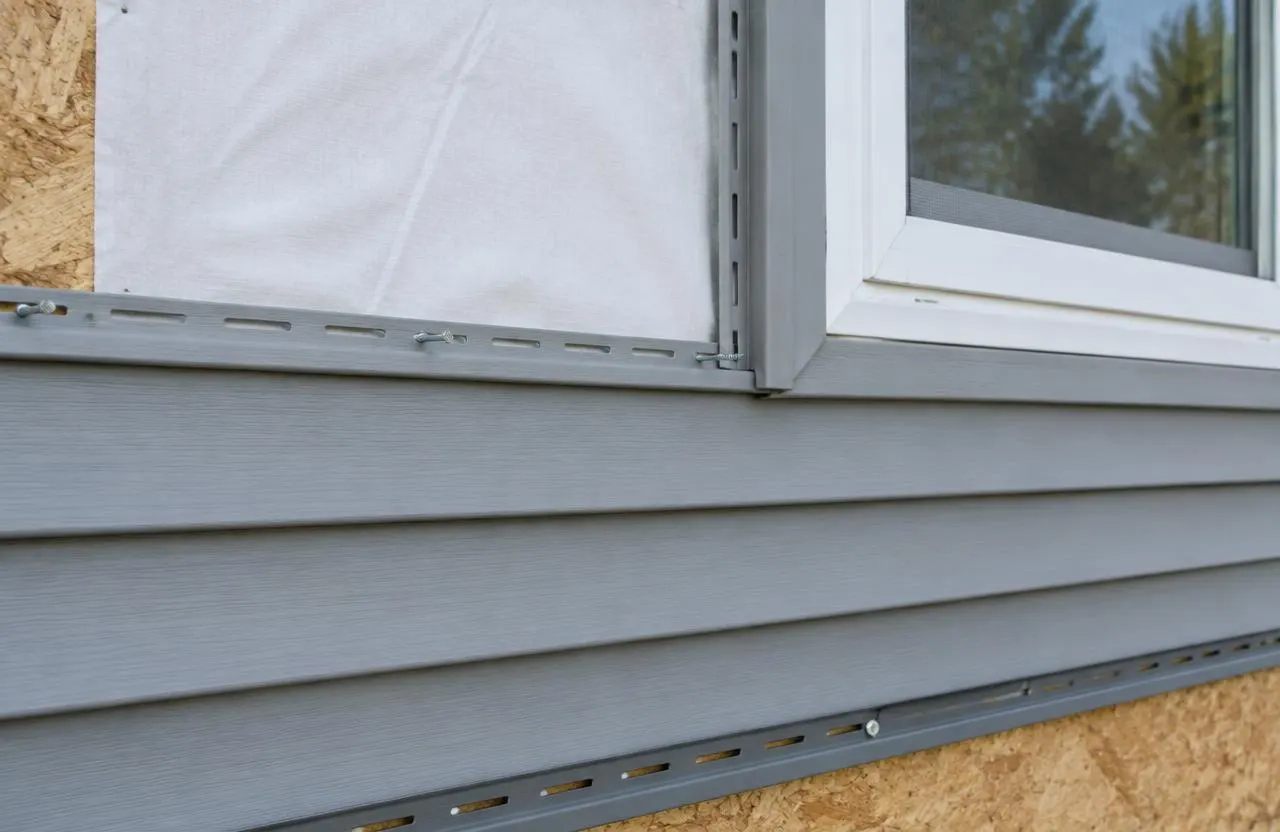
Vinyl siding lets some water past its laps and joints by design; that water drains down and out. What protects the house is the water-resistive barrier (house wrap or building paper) behind it, lapped shingle-style, and flashing at every opening. When old siding comes off, the sheathing and barrier are inspected. Rotted sheathing is replaced, and the barrier is renewed or repaired so it is continuous before new siding goes on.
Flashing at windows, doors and penetrations
Leaks behind siding almost always begin at an opening: the top of a window or door, a dryer vent, a hose bib, a light fixture, or where a roof meets a wall. Each gets flashing that directs water outward — head flashing above windows and doors, mounting blocks for fixtures and vents, and kick-out flashing where a roof edge ends against a wall. These are integrated with the barrier, not just caulked on top of the siding.
Installing for thermal movement
Vinyl expands in summer heat and contracts in Ottawa cold. Panels are fastened in the centre of their nailing slots and not driven tight, so they can slide; gaps are left at channels and trims according to the manufacturer’s instructions, with allowance for the temperature on the day. Nailing too tightly is the most common cause of buckled, rippled or cracked siding.
Trims, corners and finishing
Starter strips, J-channels, corner posts, window casings, soffit and fascia capping all have to fit together so water drains out and nothing traps it. Around windows, the siding often meets aluminum capping over the trim. Where siding meets brick, stone or a roof, the transition is flashed rather than relying on sealant.
Repair or full re-siding?
Individual cracked, melted or loose panels can usually be replaced with a matching profile, although colours fade and an exact match is not always available. Widespread buckling, repeated leaks, damaged sheathing, or siding that is near the end of its life favour re-siding. Re-siding is also the moment to add insulation board or correct flashing details — at a cost that is easier to justify than piecemeal repairs.
Colour and profile choices
Vinyl siding comes in many profiles — horizontal lap, Dutch lap, board-and-batten, shakes — and thicknesses. Darker colours absorb more heat and can move more; manufacturers specify which colours suit which exposures. Product choice should consider the manufacturer’s installation requirements and warranty terms, which depend on correct installation.
What shapes vinyl siding cost
The main factors are wall area and height, the number of windows, doors and penetrations, removal of existing siding, sheathing and barrier repairs, insulation board, the siding profile and trims, and access around the house.
Common questions
How is vinyl siding installed?
Over a sound sheathing and water-resistive barrier, with flashing at openings, starting from a level starter strip. Panels are fastened in the centre of slots, not nailed tight, with gaps at trims for thermal movement, following the manufacturer’s instructions.
Can damaged vinyl siding be repaired?
Usually, by replacing individual panels with a matching profile. Faded colours can make an exact match difficult.
When should a house be re-sided?
When damage is widespread, the siding keeps buckling, leaks have reached the sheathing, or the siding is near the end of its life.
Why is my vinyl siding wavy?
Usually because it was nailed too tightly or without room to expand, or because the wall behind it is uneven.
Is vinyl siding waterproof?
No. It sheds most water, but the barrier and flashing behind it keep the wall dry.