
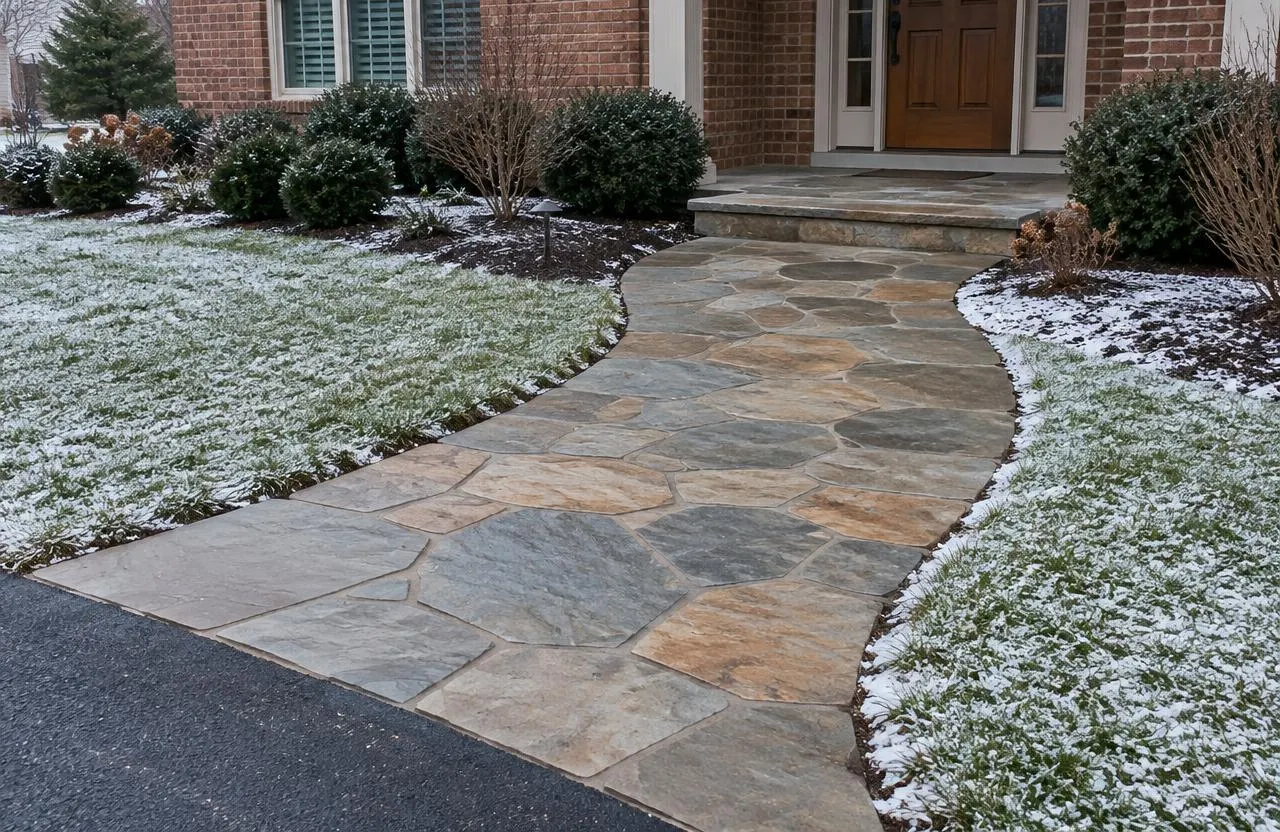
Plan the route and width first
People walk the shortest comfortable line, so a walkway that curves too much invites shortcuts across the lawn. The route connects where people actually start — the driveway, the sidewalk, a side gate — with the door they use. Width depends on use: a front walk that two people use side by side, or that carries groceries and strollers, needs more room than a garden path. Space for snow piled from shovelling or a snowblower is planned along the edges.
Slopes, steps and transitions
Changes in level are where walkways become unsafe. Gentle slopes are easier to walk and clear than a series of single steps, which people miss in poor light. Where the grade change is larger, properly built stone steps with consistent heights and a landing are used instead. The joint between the walkway and the driveway, porch or steps is kept flush so there is nothing to trip on or catch a shovel.
Drainage and the house
A walkway along the house must slope away from the foundation, and it should not dam water against the wall or create a channel toward a window well. Cross-slope keeps water from sitting on the surface, where it would freeze into ice. Downspouts that empty across a walkway are a common source of winter ice and are redirected as part of the work.
Natural flagstone vs manufactured pavers
Both make good walkways; they differ in look, consistency and maintenance.
| Natural flagstone | Manufactured pavers | |
|---|---|---|
| Look | Unique colour and texture; irregular or cut shapes | Consistent colour and size; many styles including stone looks |
| Surface | Natural cleft surfaces give good grip; thickness varies | Even surface; textured finishes available |
| Installation | More fitting and cutting; stones vary in thickness | Faster to lay; modular sizes |
| Repair | Matching stone can be hard to find later | Units can be lifted and reset; matching depends on the product staying available |
| Winter | Some stones are sensitive to de-icing salts | Some finishes show salt damage; check the product guidance |
Base, bedding and joints
Like a patio, a walkway lasts because of its base: organic soil removed, a granular base compacted in layers, and a bedding layer that suits the surface. Stone and pavers are held at the edges so they do not creep sideways. Joints can be filled with sand, polymeric sand or, for some flagstone details, mortar; each has trade-offs in movement, weeds and repair. A mortared flagstone walk on a granular base tends to crack as the ground moves, so the joint and base details are chosen together.
Winter footing and care
Textured, natural cleft and rough-finished surfaces give better grip than polished or very smooth stone. Snow clearing works better on a walkway with flush joints and a firm edge. Sand or traction grit is gentler on many stones than salt-based de-icers; check the guidance for your stone or paver. Keeping water off the surface — through slope and downspout placement — prevents more ice than any product.
Hiring a City-licensed hardscaping contractor
Since March 1, 2026, the City of Ottawa has required a hardscaping contractor licence for any business that installs, alters or paves hard landscaping features on private property — including patios, walkways and pathways, steps, retaining walls, concrete pads, gravel areas and driveways made of asphalt, concrete, interlock, pavers, flagstone, brick or similar materials. The City notes that sealing or re-sealing only of driveways or parking areas, and work on pools, decks and fences, does not need this licence.
You hire and contract the walkway contractor directly. Before signing, check that the business appears on the City’s published list of licensed hardscaping contractors — the list shows the date it was last updated, and the City’s Business Licensing Centre can confirm current status — and ask which permits, if any, the work needs. GCO’s proposal covers only the house-side work, such as entry doors, thresholds and downspouts, and coordinating the walkway layout with a renovation.
What shapes walkway cost
“How much does a stone walkway cost?” depends on length and width, the material, how much cutting curves need, steps and transitions, base depth, machine access and removal of an old walk. The licensed hardscaping contractor quotes the walkway after a site visit.
Common questions
How much does a stone walkway cost?
It depends on length, width, material, curves and cutting, steps or transitions, base work, access and removal of any existing walk. The licensed hardscaping contractor quotes after a site review.
How are stone pavers laid for a walkway?
Topsoil is removed, a granular base is compacted in layers, a bedding layer is screeded, the stones or pavers are set and edged, and joints are filled. Slope and drainage are set before the surface goes down.
Are stone walkways slippery in winter?
Smooth or polished stone can be. Natural cleft and textured surfaces give better grip, and good drainage prevents water from freezing on the surface.
Does a walkway contractor need a licence in Ottawa?
Yes. Since March 1, 2026, a business that installs, alters or paves walkways and pathways on private property needs a City of Ottawa hardscaping contractor licence. Check the City’s published list before signing.
Flagstone or pavers for a front walk?
Flagstone gives a unique natural look; pavers are more uniform and easier to repair. Both work well on a properly built base.
Can an existing walkway be fixed instead of replaced?
Often. If the base is sound, settled or loose stones can be lifted and reset. If the base has failed widely, rebuilding is usually better.