
What causes flagstone to fail
Different failures point to different causes, so the pattern of damage is read before anything is lifted.
| What you see | Likely cause |
|---|---|
| One or a few sunken stones | Soft spots in the base, washout from a downspout, or a buried void |
| Stones heaved up, worst in spring | Water trapped in the base freezing; poor drainage |
| Cracked mortar joints throughout | A rigid mortared surface over a granular base that moves with frost |
| Stones cracked across | Thin stone, a void below the stone, or a heavy point load |
| Stones lifted near a tree | Root growth under the base |
| Patio sloping toward the house | General settlement, or a base that was never graded correctly |
Fix the drainage before the stone
Resetting stones without changing what made them move usually means repeating the repair. Downspouts that empty onto the flagstone are redirected; low areas that hold water are corrected; and if the patio slopes toward the house, the repair restores the fall away from the foundation. Where water is trapped below a mortared patio, the joint and base details are part of the conversation.
Lifting, rebedding and resetting
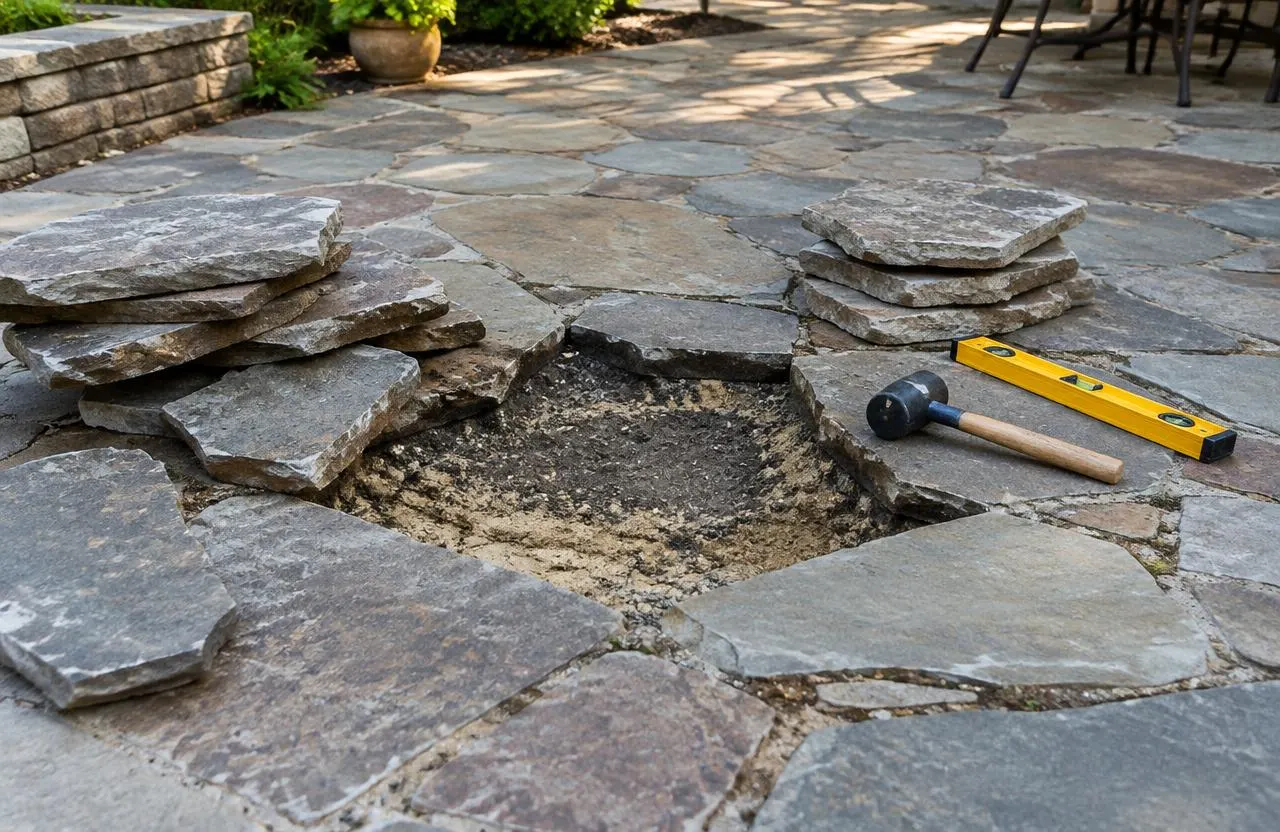
For loose, rocking or sunken stones on a sound base, the stones are lifted and numbered, the bedding is corrected and compacted, and each stone is reset to the correct level and slope. Irregular flagstone varies in thickness, so each piece is bedded individually rather than on a single flat screed. The surrounding stones are checked so the repaired area sits flush with them.
Repointing mortar joints
On mortar-set flagstone over a concrete slab, cracked or missing joints can often be raked out and repointed. On mortared stone laid over gravel or sand, cracked joints are often a sign the assembly itself is moving; repointing alone may only last a season. Ask the contractor which situation you have before agreeing to a joint repair.
Concrete-set vs granular-set flagstone
Flagstone is installed two main ways, and the repair follows the original method. Flagstone mortared onto a concrete slab behaves as one rigid surface and depends on the slab staying sound. Flagstone set on a compacted granular base with sand or polymeric joints flexes slightly and can be lifted piece by piece. A cracked or heaved concrete slab under mortared stone usually means a larger repair or a rebuild, because the problem is beneath the stone.
Replacing and matching stone
A cracked flagstone can be replaced, but natural stone varies between quarries and even between pallets. The closest available stone in type, colour, thickness and surface is sourced; sometimes the best result is to move matching stones from a less visible area to the repair and put the new stone there. An exact match is not always available.
Repair or rebuild?
Localised repairs make sense when the base is sound overall and only part of the patio has moved. Rebuilding is usually the better value when movement is widespread, the base was never adequate, the patio drains toward the house, or a mortared surface over gravel keeps cracking. In that case most of the original stone can often be reused on a new base. Interlock and concrete paver repairs follow the same principles; see patio construction for the base details.
Hiring a City-licensed hardscaping contractor
Since March 1, 2026, the City of Ottawa has required a hardscaping contractor licence for any business that installs, alters or paves hard landscaping features on private property — including patios, walkways and pathways, steps, retaining walls, concrete pads, gravel areas and driveways made of asphalt, concrete, interlock, pavers, flagstone, brick or similar materials. The City notes that sealing or re-sealing only of driveways or parking areas, and work on pools, decks and fences, does not need this licence.
You hire and contract the repair contractor directly. Before signing, check that the business appears on the City’s published list of licensed hardscaping contractors — the list shows the date it was last updated, and the City’s Business Licensing Centre can confirm current status — and ask which permits, if any, the work needs. GCO’s proposal covers only the house-side work, such as downspouts, eavestroughs, sills and siding clearance, and coordinating the repair with a renovation.
Common questions
How do you repair a flagstone patio?
Find the cause first — usually drainage, frost or base problems — then lift the affected stones, correct and compact the bedding, and reset each stone to level and slope. Joints are refilled to match the system.
How do you repair cracks in a flagstone patio?
Cracked joints on a concrete slab can usually be repointed. Cracked joints on mortared stone over gravel often mean the assembly is moving, and a longer-lasting repair addresses the base. Cracked stones are replaced.
How do you repair flagstone steps?
Loose treads are lifted and reset on a corrected base; if the whole stair has moved, its base or foundation is assessed and the stair may be rebuilt. Handrails are checked at the same time.
Can existing flagstone be matched?
The closest available stone is sourced, and sometimes existing stones are relocated to hide the new piece. Natural stone varies, so an exact match is not always possible.
Does a flagstone repair contractor need a licence in Ottawa?
Yes. Since March 1, 2026, a business that installs, alters or paves patios, walkways, steps and similar hardscaping on private property needs a City of Ottawa hardscaping contractor licence. Check the City’s published list before signing.
Is it cheaper to repair or replace a flagstone patio?
Local repairs cost less when the base is mostly sound. Widespread movement or poor drainage usually makes rebuilding — often reusing the stone — better value.