
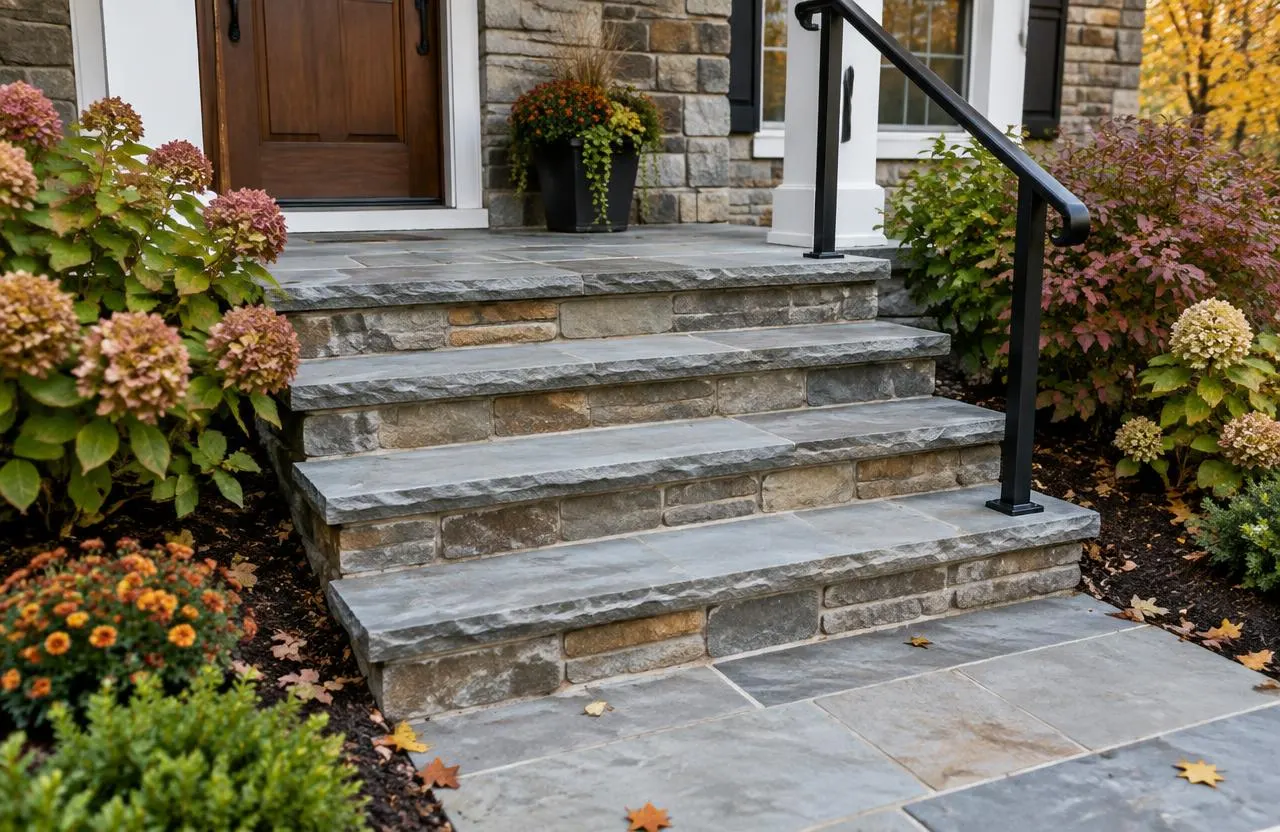
Layout: rise, run and landings
People notice uneven steps with their feet before their eyes, so every step in a run should have the same height (rise) and depth (run). Steps that change height partway are a common cause of falls. The layout starts from two fixed points — the door sill or porch and the walkway or driveway — and divides the height between them evenly. A landing at the door gives room to stand while opening it and to clear snow.
The Ontario Building Code sets requirements for exterior stairs, handrails and guards in some situations. The applicable requirements are confirmed for the actual stair during design.
Why stone steps move: frost and the base
Ottawa’s freeze-thaw cycles lift and drop anything sitting on wet soil. Steps on a thin base tend to tilt away from the house, open a gap at the porch, or rock as individual stones shift. A lasting stair sits on a well-compacted granular base taken below the soft soil, or on a foundation, depending on the stair’s size, its connection to the house and the soil. Large single-piece steps and armour stone rely heavily on what is under them.
Drainage at steps
Water that runs down the steps or collects at the bottom freezes into the worst kind of ice. Each tread is set with a slight fall so it sheds water, and the surrounding grade sends runoff away rather than into the step base or toward the foundation. A downspout emptying next to the steps is redirected.
Handrails and guards
Handrails help everyone, especially in winter and for older visitors. Where a stair or landing is high enough, guards may also be required along open sides. The rail is anchored into the stone, a post footing or the house structure in a way that stays solid as the stone moves seasonally. Whether a rail or guard is required, and its details, is checked against the applicable rules for the stair.
Choosing stone for steps
Steps take more wear and more water than a flat walk. Treads need a surface that grips when wet — natural cleft, thermal or textured finishes rather than polished stone — and a stone rated for exterior freeze-thaw use. Thick single-piece slab treads are durable and simple to clean; flagstone treads set on a built base match a flagstone walk; armour stone suits natural landscapes. Some stones are sensitive to de-icing salts, so winter care is discussed when the stone is chosen.
Rebuilding failed steps
Concrete or stone steps that have pulled away from the house, cracked or tilted usually have a base problem. Resetting stones on the same failed base tends to repeat the failure, so the contractor should assess whether the base can be corrected or the stair should be rebuilt. Precast concrete steps can sometimes be lifted and reset on a new base.
Hiring a City-licensed hardscaping contractor
Since March 1, 2026, the City of Ottawa has required a hardscaping contractor licence for any business that installs, alters or paves hard landscaping features on private property — including patios, walkways and pathways, steps, retaining walls, concrete pads, gravel areas and driveways made of asphalt, concrete, interlock, pavers, flagstone, brick or similar materials. The City notes that sealing or re-sealing only of driveways or parking areas, and work on pools, decks and fences, does not need this licence.
You hire and contract the stone step contractor directly. Before signing, check that the business appears on the City’s published list of licensed hardscaping contractors — the list shows the date it was last updated, and the City’s Business Licensing Centre can confirm current status — and ask which permits, if any, the work needs. GCO’s proposal covers only the house-side entry work, such as the door, sill and threshold and handrail anchorage into the house, and coordinating the step layout.
What shapes stone step cost
The licensed contractor’s price depends on the number of steps and the width, the stone (slab, armour stone, flagstone or precast), the base or foundation needed, removal of existing steps, the landing, handrails, access for lifting heavy stone, and connection to the walkway.
Common questions
Why do stone steps heave or tilt in winter?
Water in the soil below freezes and expands. Steps on a thin base or wet soil move with it. A deeper compacted base or foundation and good drainage prevent most movement.
Do stone steps need a handrail?
Handrails are recommended for safety, and the Ontario Building Code requires handrails and guards in some situations. The requirement is confirmed for your actual stair.
Do stone step contractors need a licence in Ottawa?
Yes. Since March 1, 2026, a business that installs, alters or paves steps and similar hardscaping on private property needs a City of Ottawa hardscaping contractor licence. Check the City’s published list before signing.
What stone is best for outdoor steps?
A dense stone rated for exterior freeze-thaw use, with a textured or natural cleft surface for grip. Slab treads are durable and easy to clean.
How much do armour stone steps cost in Ottawa?
It depends on the size and number of stones, the base, lifting access and how the steps connect to the walkway and house. A site review comes first.
Can old steps be reset rather than replaced?
If the stones are sound and the base can be corrected, often yes. Resetting on a failed base usually repeats the problem.