
Stone masonry vs stone veneer
Stone masonry builds with full-thickness stone: foundations, walls, retaining walls, chimneys and steps. Stone veneer is a thin facing applied to another wall. The repair approaches are different, and so are the risks — a stone foundation carries the house above it.
Landscape features on private property, such as retaining walls, garden steps and raised planters, are hardscaping under the City of Ottawa’s licensing requirements and are built or repaired by a City-licensed hardscaping contractor you hire directly. GCO’s stone masonry scope is masonry that is part of a building, such as foundations, walls and chimneys.
Mortar compatibility
Many older Ottawa stone foundations and walls were laid with lime-based mortar, which is softer and lets moisture move through the joints. Repointing them with hard, modern cement-rich mortar traps water in the stone and forces movement into the stone itself, which can lead to spalling and cracking. Canada’s conservation standards favour repairs that are physically compatible with the original materials. The mortar for each wall is selected after looking at the stone and the existing mortar, rather than using one mix for everything.
Repointing done properly
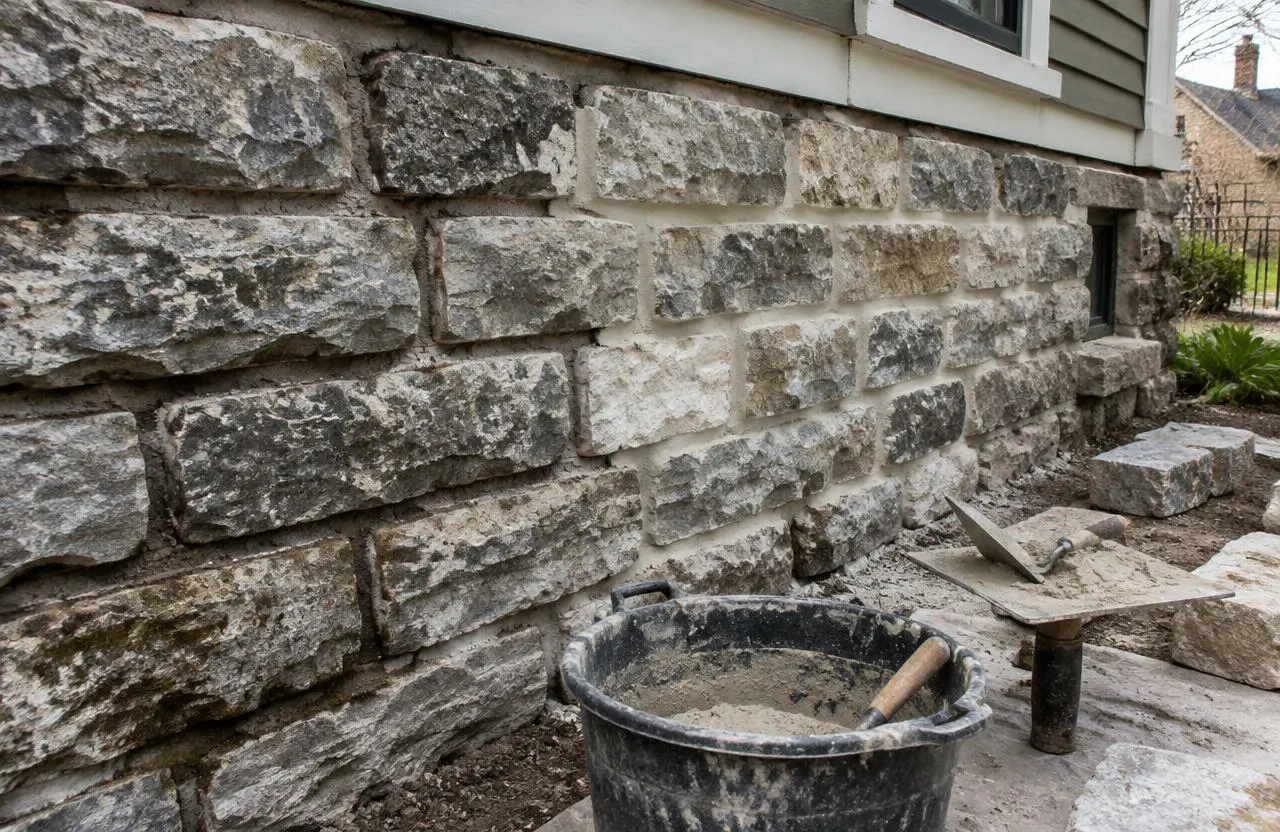
Repointing replaces deteriorated mortar at the joint face. Old mortar is raked out to a sound depth without damaging the stone edges, joints are cleaned and dampened, and new mortar is packed in layers and tooled to match. Curing matters: fresh lime mortars need protection from sun, wind, rain and frost. Repointing is seasonal work in Ottawa for that reason.
Water entry and the wall
Water is the main enemy of stone walls. Grade sloping toward the house, downspouts at the wall, gardens piled against the foundation and missing caps on garden walls all keep stone wet. Repairs last longer when the water source is dealt with — regrading, redirecting downspouts and capping — alongside the masonry. Foundation leaks may also need drainage or waterproofing work coordinated with the repair.
Rebuilding sections and matching stone
Where stones have loosened or a section has bulged or collapsed, it may need to be taken down and relaid. Original stones are reused where they are sound. Replacement stone is chosen for type, colour, size and texture to sit with the existing wall; an exact match is not always available from current quarries.
Ties, support and structural review
A bulging, leaning or cracked stone wall that carries load — a foundation, a chimney, a tall retaining wall — needs a structural assessment before repair, because repointing will not fix a wall that is moving. An engineer may specify temporary support, ties, underpinning or a rebuild.
What shapes stone masonry cost
Cost depends on the area and depth of repointing, the type of mortar, access and scaffolding, sections that need rebuilding, stone sourcing, any structural work, water-management corrections, and seasonal protection for curing mortar.
Common questions
What mortar should be used on an old stone wall?
One compatible with the stone and the original mortar — often a lime-based mortar softer than the stone. The mix is chosen after assessing the wall.
Repoint or rebuild?
Repoint when the wall is stable and only the joints have deteriorated. Rebuild sections that have loosened, bulged or collapsed, after structural review for load-bearing walls.
Can a stone foundation be repaired from the outside?
Often, by repointing and correcting drainage. Leaks and movement may need additional drainage, waterproofing or structural work.
When is repointing done in Ottawa?
In mild weather, because fresh mortar must be protected from frost and drying too quickly while it cures.
Is stone masonry the same as stone veneer?
No. Masonry builds with full-thickness stone; veneer is a thin facing on another wall.