
Measuring a room for carpet
Carpet is sold in fixed roll widths, so the amount needed depends on the room’s shape and where seams can go — not just its floor area. A rectangle narrower than the roll may need no seam at all; an L-shaped room or a room wider than the roll needs a seam plan. Pile direction must run the same way across seams and between connected rooms, or the colour will look different.
Closets, stairs and transitions are measured separately. A measured layout, rather than a square-footage estimate, is the basis of an accurate quantity and fewer visible seams.
Choosing an underpad
The underpad affects comfort, how long the carpet keeps its appearance and whether the warranty applies. Many carpet manufacturers specify the minimum density and maximum thickness of the cushion. A thicker, softer pad is not automatically better: too soft a cushion lets the carpet flex and can lead to wrinkles and seam stress.
- Rebond (bonded urethane) — common, firm and economical
- Prime urethane foam — consistent feel, various densities
- Fibre or felt pads — firm, often for low-profile or Berber carpet
- Rubber pads — dense and durable, often costlier
- Moisture-barrier pads — useful in some basements and for pet households
Tack strip, seams and power stretching
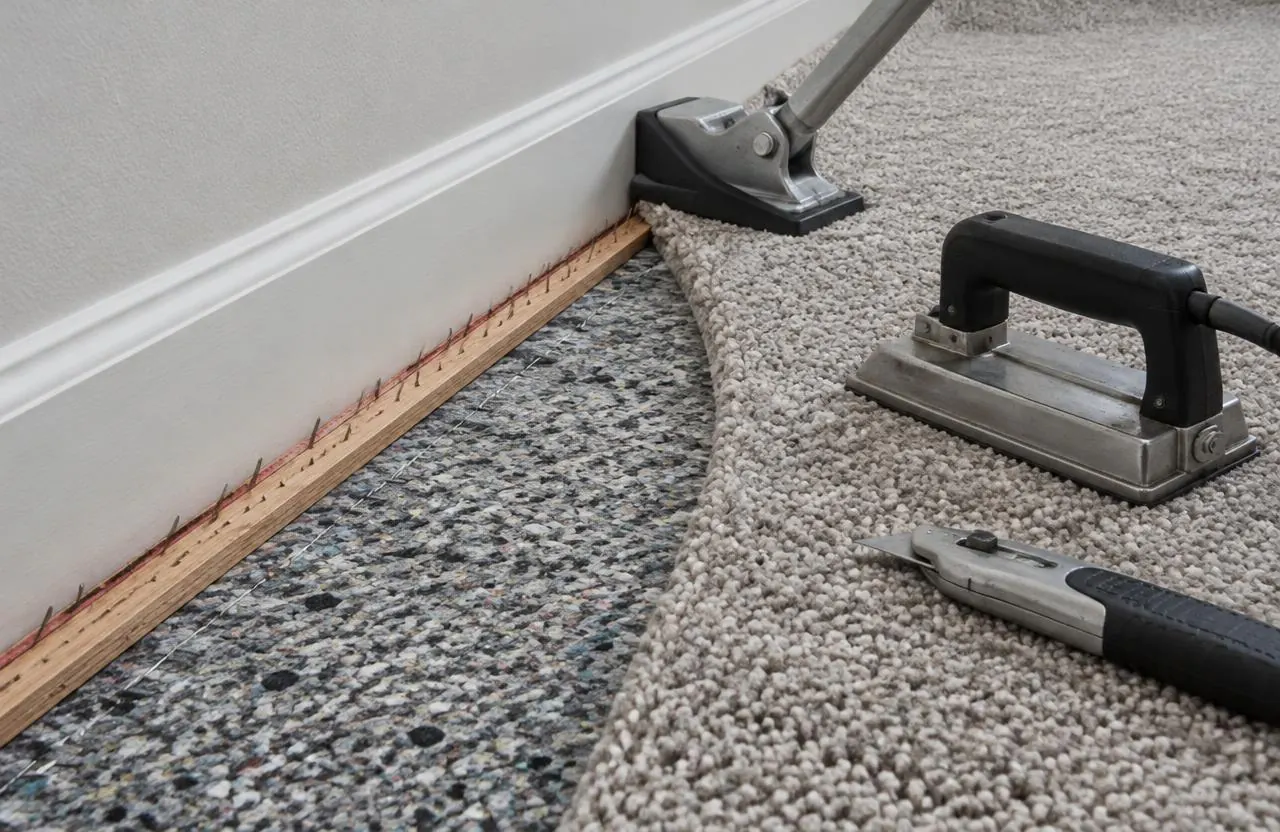
Stretch-in carpet is held at the perimeter by tack strip with angled pins and tensioned across the room. For this method, the CRI 105 residential standard (section 11.4) makes a power stretcher mandatory; a knee kicker positions carpet and hooks it at the edges but is not a stretching tool. Because backings differ, section 11.5 requires the carpet manufacturer’s stretch instructions to be followed, with a minimum fallback only for tufted carpet with synthetic backing when no instructions are given.
Glue-down carpet and modular carpet tile are not stretched in; they are installed with the adhesives and methods their manufacturers specify.
Seams are cut, sealed and joined with seaming tape and a heat iron. Placing them away from traffic paths and sunlight at windows makes them far less visible.
Carpet on stairs
Stairs are the most frequently searched carpet installation topic, and the most labour-intensive part of a carpet job. Waterfall style runs the carpet over the nosing and straight down to the next tread. Cap-and-band (often called Hollywood) wraps and fastens the carpet tightly under each nosing for a tailored look. Pile direction should run down the stairs, and each step is padded and fastened individually.
Stair runners over hardwood are another option, leaving the wood exposed at the sides.
Carpet in Ottawa basements
Carpet makes a basement feel warmer, but a concrete slab that releases moisture can lead to odours and mould under the pad. The slab’s moisture condition and any history of water should be assessed before choosing carpet. Where minor water risk remains, carpet tile with an appropriate backing can be lifted and replaced in sections.
Removal, disposal and preparation
Old carpet, pad and staples come out first, and the tack strip is inspected — some can be reused, damaged lengths are replaced. Subfloor squeaks are easiest to fix at this stage. If hardwood is found under old carpet, it is worth checking before committing; it may be a candidate for hardwood floor refinishing instead.
Doors, transitions and furniture
New carpet and pad can be thicker than what came out, so interior doors may need trimming. Where carpet meets hardwood, tile or vinyl, the transition profile is chosen for height and tripping risk. Moving furniture, beds and electronics is agreed in advance, including who disconnects and reconnects equipment.
What shapes carpet installation cost
“Carpet installation cost” is one of the most searched carpet phrases, and the answer depends on more than the carpet itself.
- Carpet type and quality, and the underpad specified
- Room layout, seams and resulting waste
- Number and style of stairs
- Removal and disposal of the old carpet and pad
- Tack strip replacement and subfloor repairs
- Door trimming, transitions and furniture moving
Caring for new carpet
Vacuum regularly, especially in the first weeks when loose fibres shed, blot spills rather than rubbing them, and follow the manufacturer’s cleaning recommendations to protect any warranty. Avoid dragging heavy furniture, which can stretch and loosen carpet over time.
Common questions
How do you measure a room for carpet installation?
Measure the room and closets, then plan around the carpet’s roll width, seam locations and pile direction. A measured layout gives a more accurate quantity than area alone.
How is carpet installed on stairs?
Each step is padded and the carpet fastened in either waterfall or cap-and-band style, with pile running down the stairs. Stairs take much longer per area than rooms.
Which carpet underpad should I choose?
Choose the density and thickness the carpet manufacturer specifies. A very soft, thick pad can shorten carpet life and void some warranties.
Is carpet a good idea in a basement?
It can be after the slab’s moisture condition is assessed. Where water risk remains, carpet tile or a hard surface may be more practical.
How long does carpet installation take?
Most rooms can be done in a day or less; stairs, removal, repairs and multiple rooms extend that. The schedule is confirmed in your proposal.
Do you remove the old carpet?
Removal and disposal of old carpet, pad and staples can be included, and the tack strip is checked for reuse or replacement.