
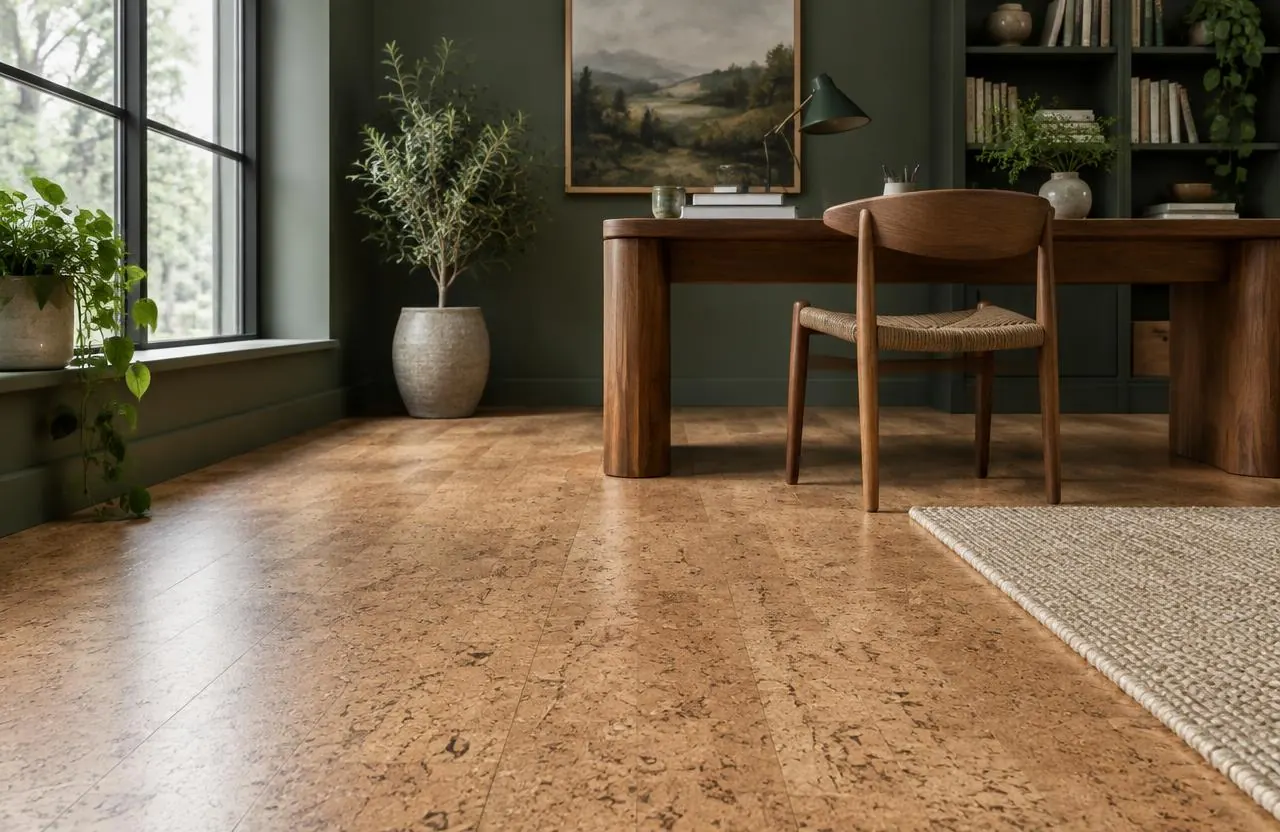
What cork flooring is
Cork is harvested from the bark of the cork oak, which regrows after harvesting. Its cellular structure is full of tiny air pockets, which is what makes it feel warm, absorb sound and spring back under footsteps. For home offices, kitchens where you stand for long periods, bedrooms and playrooms, that comfort is the main reason people choose it.
Choosing a cork format
The format matters more than the word “cork”.
| Format | Construction | Installation | Water tolerance |
|---|---|---|---|
| Glue-down cork tile | Solid cork through the thickness | Bonded to a smooth subfloor, then sealed | Best of the cork formats once properly sealed |
| Floating cork plank | Cork layers over a fibreboard core, click joints | Floats over underlayment | Core can swell if water reaches joints or edges |
| Cork-backed or cork-look vinyl | Vinyl wear surface with cork backing or print | Click or glue, per product | Follows the vinyl product’s rules |
Is cork flooring waterproof?
Not as a category. Cork itself resists moisture better than wood, and a glue-down cork floor with a continuous sealer can handle everyday kitchen spills when they are wiped up. Floating cork planks with a fibreboard core behave more like laminate: water that gets into the joints can swell the core.
Neither format is suitable for showers or areas of standing water. Treat any “waterproof” claim as product-specific and read the conditions.
Cork in Ottawa basements
Cork can feel warmer than tile or vinyl on a cool basement slab, which is why it is often asked about for basements. Suitability depends on the format and on slab moisture testing. Glue-down cork needs a dry, smooth slab and an adhesive system rated for the conditions; floating cork with a fibreboard core is more vulnerable if moisture or a minor flood occurs.
Installing cork over tile and other floors
Floating cork can often go over flat, sound tile. Glue-down cork needs a smooth, bonded surface, so tile usually has to be skimmed with a compatible patching compound or removed. Soft existing floors, like carpet or cushioned vinyl, have to come up.
Dents, furniture and sunlight
Cork recovers from everyday footsteps, but sharp point loads — narrow chair legs, appliance feet, heavy furniture — can leave lasting dents. Wide furniture cups and felt pads help. Cork also fades and changes colour in direct sunlight, so rugs should be moved occasionally and window coverings considered in sunny rooms.
Finish, recoating and care
Many cork floors are factory finished; glue-down cork is often sealed on site after installation to close the joints. Over time the finish can be recoated to restore protection, which is easier than refinishing wood. Clean with a damp — not wet — mop and the cleaner the manufacturer recommends.
What shapes cork flooring cost
“Is cork flooring expensive?” depends on format and preparation.
- Glue-down tile versus floating plank
- Subfloor smoothing or levelling
- Site-applied sealer coats and drying time
- Removal of the existing floor
- Transitions and trim
Common questions
Is cork flooring waterproof?
Not universally. Sealed glue-down cork tolerates spills; floating cork planks with a fibreboard core can swell if water reaches the joints. Neither is suitable for showers.
Is cork flooring good for basements?
It can be, depending on the format and the result of slab moisture testing. Glue-down cork on a dry slab is generally more tolerant than floating cork with a fibreboard core.
Is cork flooring expensive?
It varies by format, thickness and preparation. Glue-down cork usually needs more subfloor preparation and on-site finishing than floating cork.
Can you install cork flooring over tile?
Floating cork can often go over flat, sound tile. Glue-down cork usually needs the tile skimmed smooth or removed.
Is cork good with pets?
Cork resists scratching reasonably well and is comfortable, but claws and pet accidents still need prompt care, and point loads from crates or bowls can dent it.
Can a cork floor be refinished?
Many cork floors can be cleaned and recoated to renew the protective finish. Deep sanding is limited by the cork layer’s thickness.