
Can patio doors be repaired?
Often, yes. Patio doors are assemblies of serviceable parts, and many problems come from one of them wearing out. The question is whether parts for your door are available and whether the frame and sill are still sound. A short diagnosis answers both before you spend money on either repair or replacement.
Diagnosing common problems
The symptom usually points to the part.
| Symptom | Likely cause | Typical fix |
|---|---|---|
| Slider drags or jumps the track | Worn or seized rollers; damaged or dirty track | Clean and adjust; replace rollers; repair or cap the track |
| Lock does not catch | Door out of adjustment; worn latch or keeper | Adjust rollers or hinges; replace lock hardware |
| Drafts around the panel | Worn or missing weatherstripping | Replace weatherstripping with a matching profile |
| Fog between the panes | Failed sealed glass unit | Replace the glass unit if the frame is sound |
| Water on the floor inside | Blocked weep holes, failed sill seal, or no sill pan | Clear weeps and reseal; if the sill has failed, consider replacement |
| Hinged door sags or rubs | Loose hinges or a settled frame | Tighten or shim hinges; adjust strike |
Rollers and tracks
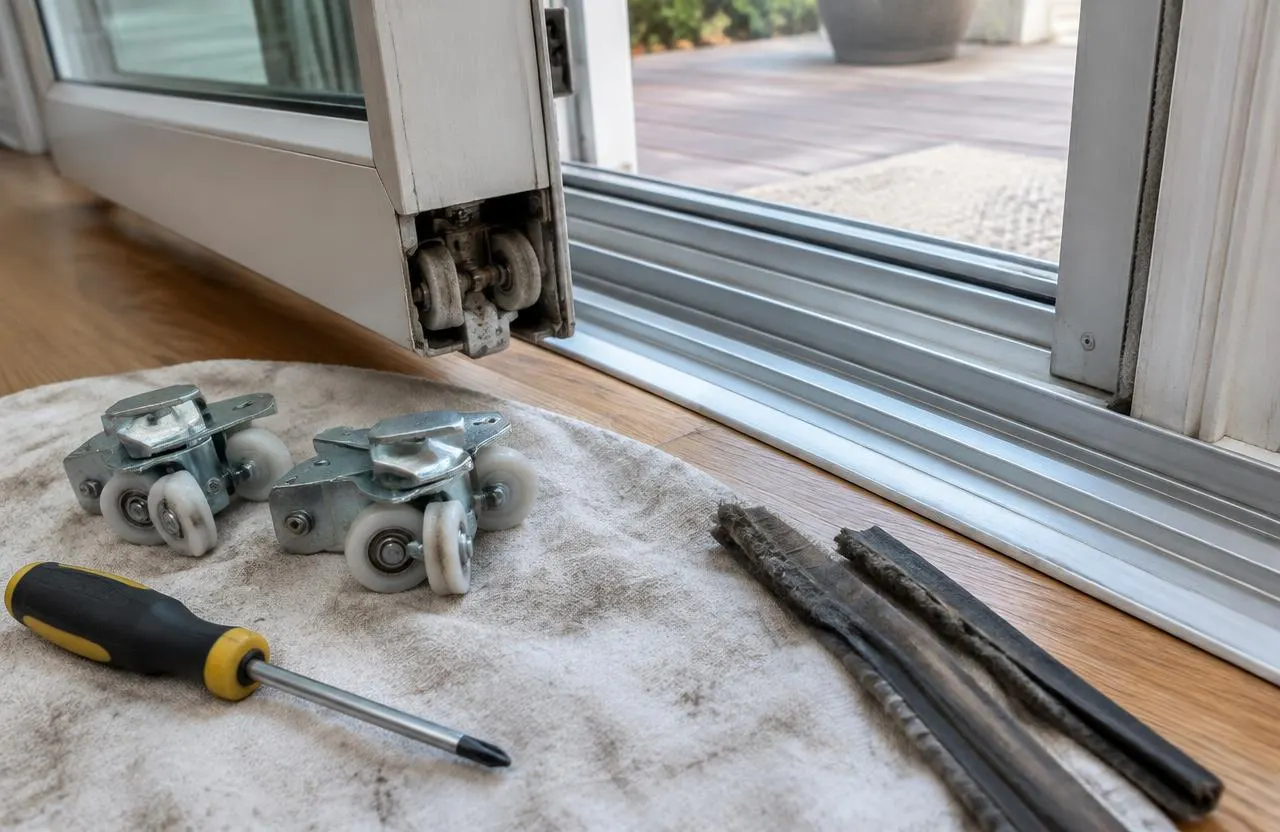
Sliding doors ride on rollers at the bottom of the panel. As they wear, the door sinks, drags and wears the track. Repairs usually mean lifting the panel out, replacing the roller assemblies with matching parts, cleaning or repairing the track, and adjusting the panel so it slides and locks properly. Questions like “how do I repair patio door rollers?” have a simple answer only when the matching part is available; panels are heavy, and the glass can break if the door is mishandled.
Locks, handles and weatherstripping
Patio door lock repair is one of the most common requests. Locks often fail because the door has dropped out of alignment, so adjustment comes before replacing hardware. Weatherstripping wears with use and sun; replacing it with the correct profile reduces drafts and noise. Parts are specific to the door’s maker and series, which is why identifying the door is the first step.
Glass seals and thresholds
Condensation between the panes means the sealed glass unit has failed. If the frame is sound, the glass unit can often be replaced on its own. Water at the inside of the threshold is more serious: if weep holes are clear and seals are intact, the problem may be the original installation — no sill pan or reversed flashing — and the rot it caused. That usually leads to replacement, because the fix is under the door.
Repair or replace?
Repair is usually worthwhile for a door whose frame is sound, whose parts are available and that does not leak through the sill. Replacement tends to make more sense when the frame is rotted or warped, parts are no longer made, several systems are failing at once, or the door has leaked into the structure. See patio doors for how replacement is planned.
Common questions
Can patio doors be repaired?
Often. Rollers, tracks, locks, handles, weatherstripping and even sealed glass units can usually be replaced if parts are available and the frame is sound.
How are patio door rollers repaired?
The panel is lifted out of the frame, the worn roller assemblies are replaced with matching parts, the track is cleaned or repaired, and the door is adjusted so it slides and locks.
Can you fix a patio door lock?
Usually. Many lock problems come from the door being out of alignment, so it is adjusted first; worn hardware is replaced with parts for that door.
How soon can a patio door be repaired?
After an assessment, the repair is scheduled subject to availability and whether parts for the door need to be ordered.
When should a patio door be replaced instead?
When the frame or sill is rotted or warped, parts are unavailable, several systems are failing, or the door has been leaking into the floor.